Skip to content
  • – “Agapē in Motion: The Neighbor We Missed”

    June 21, 2026
    Christian Faith

    Many of you know this feeling.
    You’re driving, running late, your mind already on the next thing, and you see them standing on the corner. A cardboard sign. A weathered face. Someone’s son or daughter asking for help.
    Or maybe you’re walking into a store and there’s a person sitting outside with everything they own packed into a couple of bags.
    If you’re anything like me, your heart stirs for a moment… and then your mind starts making excuses.
    “They’re just lazy.”
    “They got themselves into this.”
    “If I give them money, they’ll just buy drugs or alcohol.”
    “It’s like that scene in Liar Liar when Jim Carrey finally blurts out to the beggar, ‘I’m not giving you money because I believe you’ll just buy booze with it.’ He simply says out loud what many of us quietly think.
    We convince ourselves that our indifference is wisdom. We call it being responsible or being a good steward.
    But it doesn’t stop at red lights.
    I see it all over social media:
    “We don’t need shelters here.”
    “If they’re homeless, they should go somewhere else.”
    “We don’t want that population in our community.”
    As if moving broken people away somehow moves sin away.
    The truth is that many of the people sleeping under bridges or walking our streets aren’t outsiders. They grew up here. They went to our schools. They played on our ball fields. They sat in our churches.
    They’re our neighbors.
    And yet we label them so we can keep our conscience clean.
    “They’re addicts.”
    “They’ll just waste it.”
    We act as though addiction, mental illness, or trauma somehow strips away a person’s worth.
    But Jesus never said,
    “I was hungry, and you fed Me—as long as I’d passed a drug test.”
    He simply said:
    “I was hungry… I was thirsty… I was a stranger… I was naked… I was sick… I was in prison.”
    No conditions. No qualifiers.
    I used to think driving past was neutral.
    “I didn’t hurt them. I just didn’t help.”
    But then I read Matthew 25
    Jesus says there will come a day when people stand before Him, and He says,
    “I was hungry and you gave Me no food. I was thirsty and you gave Me no drink. I was a stranger and you did not welcome Me.”
    And they’ll ask,
    “Lord, when did we see You?”
    And He answers,
    “As you did not do it to one of the least of these, you did not do it to Me.”
    That verse has haunted me.
    Because it means Jesus ties Himself to the very people I’m tempted not to see.
    Not long ago, God stopped letting this stay theoretical.
    Every morning on my way to work, I’d see the same woman walking along the road with a bag over her shoulder. Sometimes I’d hand her a blessing bag through my window and keep driving. I’d feel that little tug in my spirit, then drown it out with excuses.
    “I don’t have time.”
    “Somebody else will help.”
    “I don’t even know what to say.”
    One morning, I couldn’t shake it.
    It felt like the Holy Spirit was sitting in the passenger seat saying,
    “You’re not driving past her again.”
    So I pulled over.
    I got out of my car and walked up the hill toward her.
    I asked her name.
    She said, “Zoe.”
    Not “the homeless woman.”
    She has a name, Zoe.
    She told me she’d been raised by her grandparents, struggled with mental illness, lost the person she was living with, and was eventually evicted. Now she keeps her belongings in a storage unit and survives however she can.
    I don’t know every detail of her story.
    But I saw trauma.
    I saw loss.
    I saw someone without a safety net or support system.
    Then I really looked at her.
    Her eyes were the exact same color as my oldest daughter’s.
    In that moment, it hit me:
    She could have been my daughter.
    She is somebody’s daughter.
    She bears the image of God just as much as I do.
    Zoe told me she believed in God but had never really read the Scriptures for herself.
    So I gave her a Bible I had with me. I had marked passages about God’s love, provision, strength, forgiveness, and hope. I tucked some cash inside.
    When I handed it to her, she looked at me and asked,
    “Are you sure you want to give this to me?”
    I told her,
    “Yes. These verses all point back to Jesus. He knows your story, and He hasn’t forgotten you.”
    We talked about local resources and places she might find help.
    Before I left, I asked if there was anything else she needed.
    She looked at me and quietly said,
    “Could you just hug me?”
    So I did.
    And she hugged me back like she meant it.
    That hug didn’t solve everything.
    It didn’t erase her pain or instantly give her a home.
    But it reminded me what love actually looks like.
    Jesus didn’t just tell us to love our neighbors. He showed us.
    He touched lepers.
    He stopped for beggars.
    He washed dirty feet.
    The Greek word for that kind of love is agapē—a sacrificial, self-giving love that moves toward people instead of away from them.
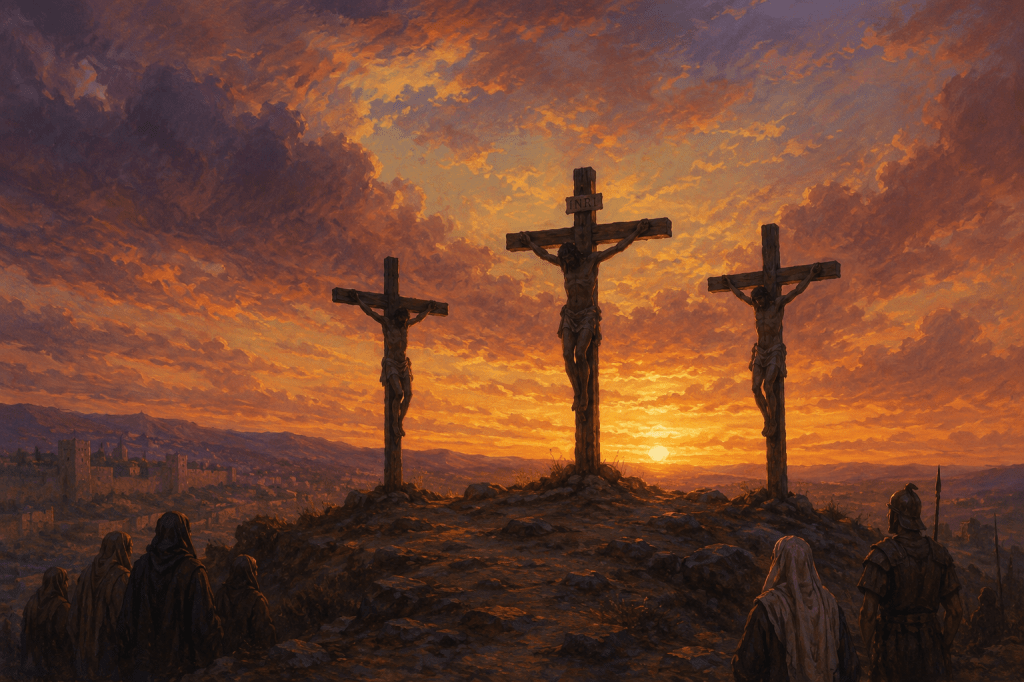
    The same love that carried Christ to the cross.
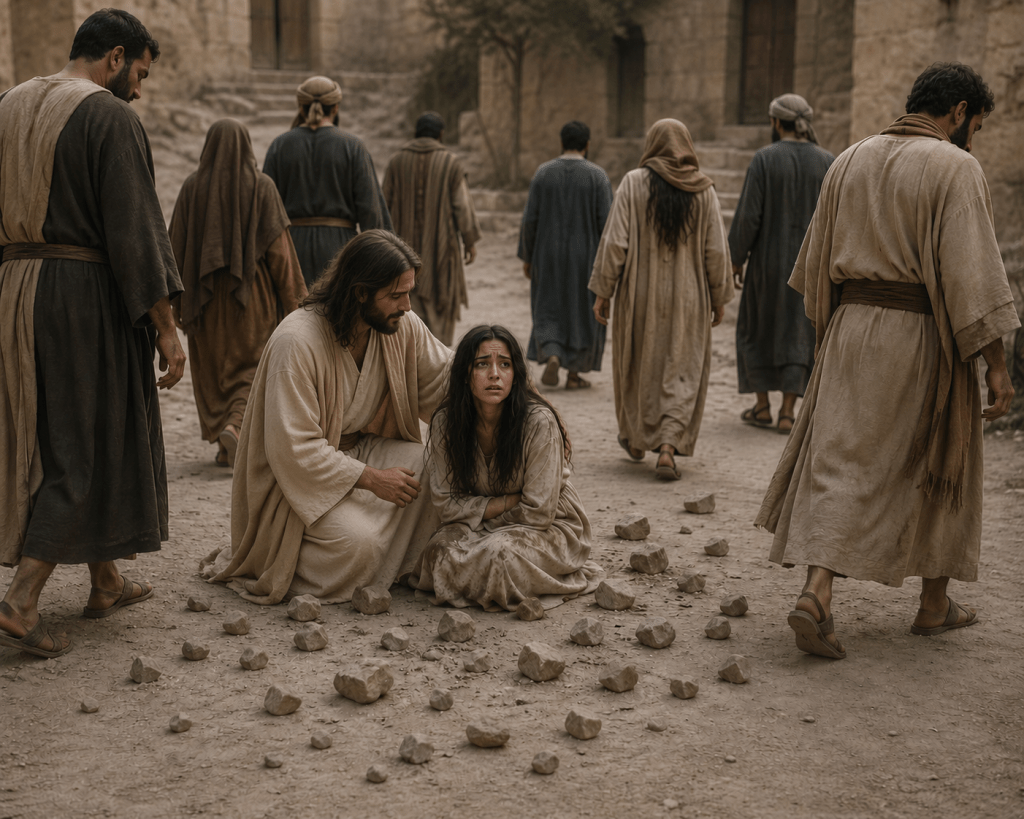
    In Luke 10, when Jesus tells the story of the Good Samaritan, the religious people cross to the other side of the road.
    The Samaritan stops.
    He sees.
    He comes near.
    He bandages wounds.
    He gives his time, his money, and his comfort.
    Then Jesus says,
    “Go and do likewise.”
    Neighbor isn’t just the person who lives next door.
    Neighbor is whoever God places in front of you.
    The man with the cardboard sign.
    The woman walking the roadside.
    The addict.
    The broken.
    The forgotten.
    The question isn’t whether they’re our neighbor.
    Jesus already answered that.
    The real question is whether we’ll cross to the other side to protect our comfort—or whether we’ll come near and show mercy.
    Because somewhere in all of this, I think Jesus is still whispering:
    “Whatever you did for one of the least of these brothers and sisters of Mine, you did for Me.”
    “So when that moment comes—the stoplight, the parking lot, the person on the corner—we’re not just deciding what to do with them. Are we practicing Agapē in Motion? ☀️ Sunnye

    No comments on – “Agapē in Motion: The Neighbor We Missed”

    For more content or Christian fellowship check out https://www.facebook.com/share/g/1Ctxu31QKg/?mibextid=wwXIfr

  • “I’m Yours as I Sleep: Childlike Prayers to Combat Sleepless Nights (The Father’s Arms Are Never Too Far Away)”

    June 21, 2026
    Christian Faith

    I am someone who has lived with chronic illness for most of my life. Some nights sleep comes easily and early. Other nights, my mind and body simply refuse to shut off. Pain lingers, thoughts race, and rest feels just out of reach. Over the years, those long nights have taught me something precious about the heart of God.

    I’m a daddy’s girl, so I know the comfort of being able to crawl into my father’s arms and know I was safe. As a little girl, I remember climbing into my dad’s lap, tucking my head beneath his chin, and feeling his arms wrap all the way around me. The world could be loud, the house could be busy, and life could feel overwhelming, but in that spot everything became small and quiet. I didn’t have to explain why I was tired, scared, or sad. I didn’t have to have the right words. I just rested there, knowing I was loved and protected.

    That is the picture I carry when I think about my Father in heaven.

    But when I come to my Father in heaven, it goes even deeper. I am my Father’s daughter.

    He doesn’t just see my face and hear my words; He sees everything. He sees the mess, the pain, the frustration, and the anger. He sees the memories I don’t talk about and the disappointments I can’t even put into words. He sees the places in me that are wounded so deeply that language fails. Psalm 139 tells us that He searches me and knows me, that He discerns my thoughts from afar, and that before a word is on my tongue, He knows it completely.

    God doesn’t get impatient with me there. He isn’t frustrated that I’m not praying better or that I don’t have the perfect words. He meets me exactly where I am.

    Yes, there are times when prayer should be fervent, alert, and intentional. But there is also something beautiful about reaching the end of a long day, after the prayers have been prayed and the thanksgiving has been offered, and simply drawing near to Him.

    Sometimes my prayer becomes nothing more than, “Daddy… Father in heaven… can I just be with You now?”

    And He never tells me no.

    He never tells me now is not the time.

    He welcomes me.

    What follows is one of the purest acts of worship I know: surrender.

    Not a surrender of defeat, but a surrender of trust. Open hands. Open heart. A willingness to place every part of myself into His care.

    Full surrender is yielding every part of yourself to God—your plans, fears, desires, pain, future, relationships, successes, failures, and even your understanding—while trusting Him to lead and care for you. It is not giving up; it is giving over.

    Full surrender says:

    “God, Your will is more important than mine.”

    “I trust You even when I don’t understand.”

    “My life belongs to You, not me.”

    “I will obey even when it is uncomfortable.”

    “I release my need to control the outcome.”

    Full surrender doesn’t mean I never struggle. It doesn’t mean I never ask questions, feel afraid, or experience pain. It means that in the middle of those things, I continue placing myself into God’s hands.

    For someone living with chronic illness, surrender often sounds like this:

    “Father, I don’t understand why my body hurts. I wish things were different. But whether You heal me today, tomorrow, or in eternity, I belong to You. My life is Yours. My suffering is Yours. My future is Yours. I trust You with what I cannot carry.”

    Then I simply whisper:

    “God, I’m Yours. I’m Yours while I sleep. If there is something in my heart that still needs to be spoken, something that needs to be brought before You, use it. Use my dreams. Use my breathing. Use this quiet moment. Here is all of me. Do with me what You will.”

    That is the posture of a child climbing into her Father’s lap and saying:

    “I don’t have all the answers. I don’t know how this story ends. But I know You. So I will rest in Your arms and trust You with all of me.”

    This is what childlike faith looks like.

    Jesus said in Matthew 18:3, “Truly I tell you, unless you turn and become like little children, you will never enter the kingdom of heaven.”

    Little children don’t overanalyze their father’s love. They don’t strive to earn their place in his arms. They simply climb up, lean in, and trust that they are safe. That is the posture God invites us into.

    And on the nights when I can’t find the words—when pain is overwhelming, exhaustion has taken over, or my heart is simply too heavy—Romans 8:26-27 brings incredible comfort:

    “The Spirit helps us in our weakness… the Spirit himself intercedes for us through wordless groans.”

    Even when my mouth is silent, heaven is not.

    The Holy Spirit carries every burden, every fear, every tear, and every unspoken prayer to the Father who already knows. He intercedes when I can’t. He prays when I have no strength left.

    So when I finally lay down at night, I picture myself curling up in the lap of my Father. Psalm 4:8 says:

    “In peace I will lie down and sleep, for you alone, Lord, make me dwell in safety.”

    I am not merely collapsing from exhaustion. I am surrendering myself into His care. I am placing every burden, every ache, every unanswered question, and every fear into His hands. I am allowing Him to hold the parts of me that are too heavy to carry one more step.

    And I rest knowing that the same God who sustained me throughout the day is watching over me through the night. He guards my mind, comforts my heart, and sings over me as I sleep. Even my breathing becomes an expression of trust.

    Because I am His daughter.

    And I am safe in my Father’s arms.

    Love your sister in Christ, ☀️Sunnye

    No comments on “I’m Yours as I Sleep: Childlike Prayers to Combat Sleepless Nights (The Father’s Arms Are Never Too Far Away)”

    For more content or Christian fellowship check out https://www.facebook.com/share/g/1Ctxu31QKg/?mibextid=wwXIfr

  • If you don’t plant any seeds you can’t be shocked on the Harvest.

    June 13, 2026
    Uncategorized

    If all I ever plant are excuses, fear, and my own comfort, I cannot be shocked when there is no harvest of joy, mercy, or transformed lives. We love to talk about ‘reaping what we sow,’ but we forget the flip side: if I never actually share Christ with anyone, why am I surprised when there’s no fruit? I don’t get to custom‑order the kind of sinners I’m willing to love. God puts real neighbors in front of me – the mentally ill, the homeless, the addict, the thief, the one who makes my skin crawl – and then asks, ‘Will you love this one, too?’

    The Great Commandment and the Great Commission are not theory; they have an address. My cul‑de‑sac, my workplace, Westport Road, exit zero, my Walmart parking lot. If I refuse to plant the seed of the gospel there, I can’t stand before God later and complain about the lack of harvest. The issue isn’t that the soil was too hard; half the time, it’s that I never opened my mouth or my Bible. No one is too far gone to repent, but they may be too far from anyone willing to bring them the Name that saves. If I won’t even lay a Bible in the hands of the outcast, then I need to stop pretending I’m ready for ‘ministry’ in some cleaner, safer field.

    However before I ever talk about harvest, I have to listen to what Romans 10 says about how God actually saves people. ‘Everyone who calls on the name of the Lord will be saved’ (Romans 10:13), but Paul doesn’t stop there. He asks, ‘How, then, can they call on the one they have not believed in? And how can they believe in the one of whom they have not heard?’ (Romans 10:14). If my neighbor has never heard the Name from my porch, my driveway, my side of the fence, how will he call on Him? I keep wanting a harvest of saved souls while refusing to be the voice that carries the gospel down the street. Romans 10 won’t let me pretend those two things are separate.

    Romans 10 reminds me people can’t call on a Jesus if they’ve never heard about Him. Galatians 6 reminds me that what I plant actually matters. ‘Do not be deceived: God is not mocked. For whatever a person sows, he will also reap’ (Galatians 6:7). If all I ever sow toward those God puts in my path is avoidance, fear, and gossip, why am I shocked when the harvest is more darkness and more brokenness on my street? Paul doesn’t just warn about bad seed; he invites me to ‘sow to the Spirit’ and ‘not become weary in doing good, for at the proper time we will reap a harvest if we do not give up’ (Galatians 6:8–9). Planting a Bible in hands of the lonely, accused, addicted, and troubled, a conversation, a kind but honest word about Jesus may feel small, but in God’s economy that is Spirit‑seed, and Spirit‑seed always has harvest potential.

    “Anyone who knows me knows I love Bibles. Different colors, translations, sizes, styles – I’ll carry one for a whole season and just live in it. Lately the Lord has had me doing something new with them: instead of just keeping these well‑loved treasures to myself, I’ve started giving them away to whoever He lays on my heart. I don’t hand out ‘clean’ Bibles either; I share the ones I’ve actually cried over, highlighted in, written little love notes and prayers in, with Post‑its sticking out the sides.

    I never know who might need to see, in the margins, that they’re not the only one who has wrestled with that verse or that struggle. It’s one thing to read, ‘God loves you’ in printed text; it’s another to see, in someone else’s shaky handwriting, ‘He met me here when I thought I was done.’ Those Bibles become a quiet way of saying, ‘You’re not alone, and Jesus walks with worn‑out, messed‑up people like us.

    At the end of the day, Romans 10 and Galatians 6 won’t let me hide behind my excuses. If I want a harvest, I have to open my mouth and my Bible, even when the person in front of me is the last one I would have chosen. The same Jesus who met me in my mess is able to meet them in theirs. My job is not to fix them or to clean up the story; my job is to plant the seed, slide the worn‑out Bible across the table, knock on the door, and trust that the Lord of the harvest knows exactly what to do with every shaky, obedient yes.” Love your Sister in Christ Sunnye 🔆

    No comments on If you don’t plant any seeds you can’t be shocked on the Harvest.

    For more content or Christian fellowship check out https://www.facebook.com/share/g/1Ctxu31QKg/?mibextid=wwXIfr

  • Forty Days, Forty Nights: Where Are You in Your Wilderness?

    June 7, 2026
    Uncategorized

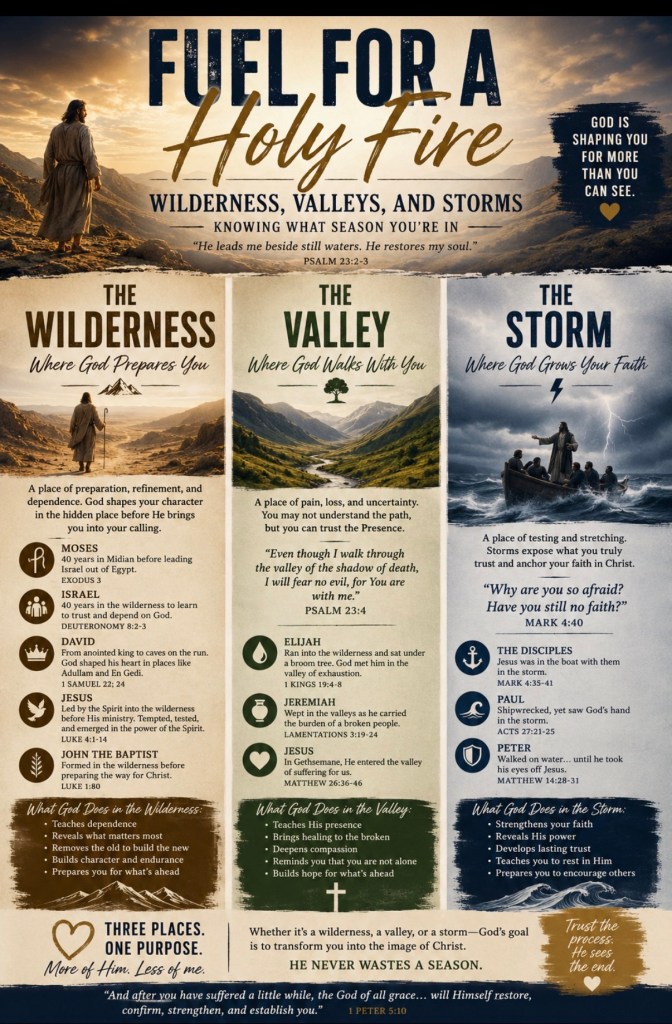
    There is a wilderness for many in their walk in faith , and it is rarely forty calm, quiet mornings with a latte or for me a diet mountain dew. It is forty days and forty nights of hunger, forty scans, forty sleepless weeks, forty plus years of carrying a body that does not cooperate. We act like the wilderness is the exception, but if you belong to Jesus, this is kind of the normal. This is where the Spirit leads you, and where the enemy leans close and runs the same three plays he ran on Christ.
    First temptation comes the stones and the bread.
    “Turn this into relief. Right now. If you are really His, He will not let you sit in this much pain.” For me, it sounds like, “Fix this body, remove these autoimmune diseases. Fix this fatigue. Take whatever edge‑numbing thing is in front of you and call it self‑care.” It is the offer to live on bread alone – on comfort, on meds, on distraction – instead of on the word from the mouth of God. But Jesus answers, “It is written, ‘Man shall not live by bread alone, but by every word that comes from the mouth of God’” (Matthew 4:4; Deuteronomy 8:3). My forty days feel like lying there with a body screaming for shortcuts and having to say, “My life is not in how fast this calms down. My life is hidden in what He has already spoken.” That is wilderness lesson one.
    Then comes the temple.
    “Prove it. Make God perform for you. Make Him do something impressive so everyone finally shuts up.” In my world, that is the fantasy of one big healing that erases every accusation: one clean report, one dramatic turnaround, one promotion or platform that makes it obvious I am not lazy, not faking, not faithless. It is the itch to say, “Okay God, throw me off this cliff and catch me in front of the whole office, the whole family, the whole internet.” Forty days can feel like forty opportunities to dare God to put on a show. But when the enemy quotes Scripture at Jesus, twisting Psalm 91, Jesus answers, “Again it is written, ‘You shall not put the Lord your God to the test’” (Matthew 4:7; Deuteronomy 6:16). Joy in the wilderness is learning to worship without demanding a stunt, to say, “You are God even if You never give me the scene I scripted.”
    Finally, the mountain.
    When you are tired enough, the offer to skip the cross starts to sound reasonable. “All this can be yours. The ease, the influence, the image of having it all together. Just bow a little. Bend truth here, control harder there, worship the outcome instead of the One who writes it.” My forty days are full of those little bargains: “If I over‑manage everyone, maybe I can finally rest. If I soften Your word so it does not offend, maybe I can have a bigger audience. If I live for the approval in front of me, maybe I will not have to feel so small and unseen.” The wilderness pulls back the curtain and shows me which kingdom I really want. And when Satan offers Jesus “all the kingdoms of the world and their glory” if He will just bow, Jesus answers, “Be gone, Satan! For it is written, ‘You shall worship the Lord your God and him only shall you serve’” (Matthew 4:10; Deuteronomy 6:13). The only way out for me is the same way He walked, by picking up my cross and following him: “Get out Satan! I know Who I worship. I will bow to God alone, even if that means I stay on this hard road longer. I know the one who holds my today, my tomorrow, and my forever.”
    Because underneath every offer in the wilderness is the same ugly goal: Satan wants worship. He is not content for me to just make a bad choice; he wants my gaze, my agreement, my bend at the knee. He wanted to be bigger than God in the beginning, and he still wants that throne in my little life right now. If he can get me to bow to comfort, to spectacle, or to control, he has dragged my worship away from the only One who actually deserves it.
    So I have to stop and ask: where am I in this wilderness?
    Am I in the “stones to bread” days, where all I want is for the pain to stop and I am tempted to grab any fake relief in front of me?
    Am I standing on the edge of the temple, daring God to put on a show so I can finally feel vindicated?
    …Or am I up on the mountain, eyeing all the kingdoms and wondering if it would really be so bad to take a shortcut, to bow just a little, so I can feel in control again?
    Maybe you are at the place where your faith feels thin and cracked, and you do not even know if you believe He is good anymore. Maybe you are so tired you are ready to hand the steering wheel to anybody who promises quick peace. Can I just say this: lift your eyes. The same Jesus who walked through forty days and forty nights in the wilderness without sin is the same Jesus who walked every single day of His earthly life without sin. He was perfectly righteous in a real human body, on real dusty roads, with real temptation pressing in on every side. He is the only One who has actually defeated the tempter.
    So name it. Name your wilderness. Name your current temptation. Where is the enemy whispering, “Turn these stones to bread,” “Jump and make God catch you,” or “Bow here and take control back”? Then answer it out loud with what is written – the same way Jesus did. “It is written: I do not live on bread alone. It is written: I will not put the Lord my God to the test. It is written: I will worship the Lord my God and serve Him only.”
    And hear this: this wilderness is not wasted. It is not proof that God forgot you; it is one of the places He is growing your faith. You may not see the purpose it serves right now, but it serves a purpose – to strip away false worship, to teach you His voice, to anchor you in what is written instead of what you feel. Your forty days may feel long, but they are not forever. The wilderness is not the whole story. The One who walked through it without sin, who stayed faithful every step of His earthly life, is with you in yours – and His kingdom is the only one that will still be standing when your forty days are over.

    “Holding fast with you in the wilderness,
    your sister in Christ,
    Sunnye ☀️”

    No comments on Forty Days, Forty Nights: Where Are You in Your Wilderness?

    For more content or Christian fellowship check out https://www.facebook.com/share/g/1Ctxu31QKg/?mibextid=wwXIfr

  • Reflections from the Drive

    June 4, 2026
    Uncategorized

    “This morning driving in, I was thinking about how God really is in everything.
    He is sovereign over everything. Scripture says that all things were created by Him, through Him, and for Him—nothing is outside His hands, not even my messy commute.
    Driving in this morning, my windshield was covered in bug splatter and grime. I could still technically see, but every bit of sun glare turned those little spots into big distractions. My husband keeps reminding me I need washer fluid, need to use it more and my windshield is so dirty he can’t see out it, but it hit me that my heart and spirit works the same way.
    Every day, stuff hits our ‘spiritual windshield’—’spiritual lens’ stress, compromise we call ‘no big deal,’ bitterness we never deal with, constant noise.
    We’re still moving, still going to work and church, but the view of God and what’s actually true gets more and more smeared.
    We start wondering why everything feels confusing and heavy, why we can’t see what God is doing. But bug guts and road grime aren’t my deepest problem.
    The truth is, without the blood of Jesus I don’t even have a way to be clean. The cross is where the real washing starts.
    We don’t just need a little positivity or a reset; we need to actually receive what Christ did for us, let His blood wash over our sin, and let His Spirit make us new.
    Then, day after day, the Holy Spirit and the Word of God are our wipers and washer fluid. They don’t change the fact that we’re driving through a messy world, but they keep the mess from crusting over our vision.
    As we stay in the Word and stay surrendered to the Spirit, He keeps wiping away what hits us so we don’t slip back into driving blind.
    And here’s the wild part: God is sovereign over all of it. The same God who made the sun that glares on my dirty windshield is the One using a messy commute to tap me on the shoulder.
    When we actually want to see Him, when we seek Him with real hearts, He lets us find Him—in bug splatter, in windshield wipers, in traffic, in hospital rooms, in ordinary Tuesdays.
    Nothing is random. If you’ll ask Him, the Holy Spirit will use even the little things in front of you today to turn your eyes back to Jesus.
    If you feel stuck, foggy, or lukewarm right now, it might not be that God walked away. It might be that your washer fluid is low. Come back to the cross.
    Open your Bible. Ask the Holy Spirit to wash your mind and heart again. Let Him clear the glass so you can see Jesus clearly and follow Him without guessing.”
    From my morning commute to from Salem Indiana to Louisville, Kentucky. ☀️Sunnye Anne

    No comments on Reflections from the Drive

    For more content or Christian fellowship check out https://www.facebook.com/share/g/1Ctxu31QKg/?mibextid=wwXIfr

  • When Believers Fear Their Own Tools: AI, Control, and the Cross. God is still sovereign over it All!

    June 4, 2026
    Uncategorized

    In a world panicking about artificial intelligence and new technology, I keep coming back to this: God has never once lost control. Daniel 2:20–21 says He’s the One who “changes times and seasons” and raises up and removes kings. Colossians 1:16–17 says that all things were created through Jesus and for Him, and that in Him all things hold together. Hebrews 1:3 says He upholds the universe by the word of His power. Psalm 115:3 reminds us, “Our God is in the heavens; he does all that he pleases,” and Proverbs 16:9 says that while we plan our way, the Lord is the One who establishes our steps. That means every data center, every line of code, every “new thing” is still sitting inside His sovereignty. People can absolutely misuse technology, twist it, and even try to build new Towers of Babel with it—but Genesis 50:20 and Romans 8:28 remind us that even what’s meant for evil, God can turn for good for those who love Him. The real issue isn’t the tools; it’s the hearts holding them. As followers of Jesus, we have the chance to take these same tools and aim them at worship, truth, mercy, and the gospel—using what the world fears to point back to the One who sits above it all and holds every server, every system, and every breath in His hands. ☀️Sunnye Anne

    No comments on When Believers Fear Their Own Tools: AI, Control, and the Cross. God is still sovereign over it All!

    For more content or Christian fellowship check out https://www.facebook.com/share/g/1Ctxu31QKg/?mibextid=wwXIfr

Previous Page
1 2 3

Website Built with WordPress.com.

Holy Moments in a Worn‑Out Life: Time Well Spent Turning Back to the Word

A worn-out body, a cracked world, and a faithful Savior who loves my soul. 🔆Sunnye Anne

    • 911 EMERGENCY SCRIPTURES – When you don’t know where else to turn, start here.
    • About me
    • Men of Faith of the Bible… Case Study: Daniel
    • Men of Faith of the Bible… Case Study: David
    • Men of Faith of the Bible… Case Study: Paul formerly Saul
    • Women of the Bible… Case Study: Esther
    • Women of the Bible… Case Study: Hagar
    • Women of the Bible… Case Study: Rahab
    • Women of the Bible… Case Study: Ruth
    • Women of the Bible… Case Study: Sarah
    • You Were Never Meant to Carry This Alone
Loading Comments...
  • Subscribe Subscribed
    • Holy Moments in a Worn‑Out Life: Time Well Spent Turning Back to the Word
    • Already have a WordPress.com account? Log in now.
    • Holy Moments in a Worn‑Out Life: Time Well Spent Turning Back to the Word
    • Subscribe Subscribed
    • Sign up
    • Log in
    • Report this content
    • View site in Reader
    • Manage subscriptions
    • Collapse this bar