Skip to content
  • If You Can’t See the Bottom

    July 16, 2026
    Uncategorized

    When I was growing up, we had a pool in our backyard.

    There was one rule that never changed.

    Especially if you didn’t know the water.

    If you can’t see the bottom, you don’t dive in.

    It didn’t matter how hot it was.

    It didn’t matter how badly you wanted to jump in.

    If the water was cloudy, you waited.

    As a kid, I thought it was just a safety rule.

    As an adult, I think it describes the human heart.

    Yesterday a friend was testing the water in his swimming pool. The pH was right where it needed to be, but the chlorine was too high. Watching him check the chemistry made me think about how much time we spend trying to fix water—and how often we treat our souls the very same way.

    We keep testing.

    Adjusting.

    Pouring something else in.

    Trying to get everything balanced just right.

    Because most of us don’t mind taking risks—as long as we’re still in control.

    We want to know where we’ll land before we leap.

    We want guarantees before obedience.

    We want certainty before surrender.

    We want to see the bottom.

    And somewhere along the way we’ve convinced ourselves that following Jesus works the same way.

    We stand on the edge of surrender, the edge of obedience, the edge of repentance, staring into the cloudy water of our own hearts, saying,

    “I’ll jump when I can see the bottom.”

    “I’ll surrender when I know how this is going to go.”

    “I’ll trust Him once I’ve cleaned some things up.”

    We treat following Jesus like a pool we’re responsible to maintain.

    If we can just get the chemistry right…

    Enough quiet time.

    Enough Bible reading.

    Enough prayer.

    Enough serving.

    Enough “good Christian” behavior.

    Then maybe the water will finally be clear enough for God to be pleased with us.

    Clear enough for us to stop feeling ashamed.

    Clear enough to finally approach a holy God.

    But here’s the truth every one of us has to choke down.

    You are not the pool boy of your own salvation.

    You cannot shock your heart into holiness.

    You cannot scrub your way into righteousness.

    You cannot measure, pour, test, and retest until your soul reaches perfect chemistry.

    If you could fix your own water, Jesus never had to come.

    Paul writes,

    “While we were still weak, at the right time Christ died for the ungodly” (Romans 5:6).

    Titus says He saved us,

    “not because of works done by us in righteousness, but according to His mercy” (Titus 3:5).

    The gospel has never been,

    “Get yourself together, then come.”

    The gospel has always been,

    “Come, and I will make you new.”

    That’s where we’ve twisted the story.

    Especially if you’re carrying something heavy.

    The addict says,

    “I’ll come back once I’m finally sober.”

    The one trapped in pornography says,

    “I’ll return after I’ve gone long enough without failing.”

    The angry person says,

    “I’ll pray again once I stop losing my temper.”

    The bitter heart says,

    “I’ll get close to God after I finally let this go.”

    Every one of those lies says the same thing:

    “I’ll come…once I’ve cleaned my own water.”

    But Jesus never said,

    “Come after you’ve finally gotten your life together.”

    He said,

    “Come to Me, all who labor and are heavy laden, and I will give you rest.” (Matthew 11:28)

    Notice who gets invited.

    The weary.

    The burdened.

    The exhausted.

    Not the polished.

    Not the impressive.

    Not the ones who finally figured it out.

    The ones carrying weight they can no longer carry.

    So come.

    Come while the bottle is still calling your name.

    Come while yesterday’s failure is still replaying in your mind.

    Come while the shame still burns.

    Come while your water is cloudy.

    Because your freedom has never depended on your ability to rescue yourself.

    It depends on the Savior.

    Maybe that’s why Psalm 130 has become one of my favorite psalms.

    It doesn’t begin on the pool deck.

    It begins underwater.

    “Out of the depths I cry to You, O LORD.”

    The Hebrew word translated “depths” (mimmaʿămaqîm) literally describes the deep places—the places where your feet can’t touch, where you can’t see the bottom, where you realize you cannot save yourself.

    The writer doesn’t cry after climbing halfway back to the surface.

    He cries from the bottom.

    Everything that follows—forgiveness, hope, waiting, redemption—begins because God listens to people who are already in over their heads.

    We fear the depths because we think they’ll destroy us.

    God enters the depths because that’s where He rescues us.

    Micah paints the same picture from another angle.

    “He will again have compassion on us.”

    The Hebrew word for compassion (racham) comes from the word for a mother’s womb.

    It speaks of deep covenant mercy.

    Not detached sympathy.

    Not reluctant forgiveness.

    A love that keeps moving toward His children.

    Then Micah says,

    “He will trample our iniquities underfoot.”

    God doesn’t negotiate with sin.

    He conquers it.

    Then comes one of the most beautiful promises in Scripture.

    “You will cast all our sins into the depths of the sea.”

    The word “cast” means to hurl away intentionally.

    Not set aside.

    Not shelved for later.

    Thrown where they will never be recovered.

    Every failure.

    Every hidden shame.

    Every addiction.

    Every secret.

    Every sin you’ve confessed a hundred times.

    Every one you’ve never told another soul.

    Gone.

    Do you see the irony?

    The place you feared most…

    Becomes the place where God buries your sin.

    The depths you thought would become your grave…

    Become the place where grace proves it is deeper still.

    The whole Bible tells that story.

    Jonah was rescued in the depths.

    Israel walked through the depths of the sea.

    Peter was sinking into the depths when Jesus reached out His hand.

    Jesus Himself entered the deepest waters of suffering, bore the full weight of our sin, passed through death, and walked out of the grave victorious.

    Again and again, God meets people where they cannot rescue themselves.

    Maybe you’ve been standing on the edge for a long time.

    Waiting until you can see the bottom.

    Waiting until you understand.

    Waiting until you’ve conquered that sin.

    Friend, you’ll wait forever.

    The invitation of Jesus has never been,

    “Come once you’ve cleared the water.”

    It’s always been,

    “Come.”

    Come trembling.

    Come exhausted.

    Come honest.

    Come with the whole cloudy mess.

    Stop trying to be your own lifeguard.

    Stop trying to be your own pool boy.

    Stop trying to be your own savior.

    Bring the whole murky mess into the light.

    Confess it.

    Repent of it.

    Trust the One who isn’t frightened by what lies beneath the surface.

    Because repentance isn’t bleaching yourself into something lovable.

    Repentance is dragging your whole cloudy heart into the light and agreeing with God about what is there, while trusting that His mercy is greater than your mess.

    He is not afraid of cloudy water.

    He already knows what’s sitting at the bottom.

    And He isn’t asking you to clean it up.

    He’s asking you to trust Him with it.

    Because we fear the depths, believing they’ll destroy us.

    But God enters the depths because that’s where He rescues us. Love your sister in Christ 🔆Sunnye

    No comments on If You Can’t See the Bottom

    For more content or Christian fellowship check out https://www.facebook.com/share/g/1Ctxu31QKg/?mibextid=wwXIfr

  • Broken but not forsaken

    July 11, 2026
    Christian Faith

    We live in a broken world. We drive broken cars, live in broken houses, have broken marriages, broken families, broken children, broken phones, and broken bodies. The truth is—we’re broken too.

    There’s an ache deep inside every one of us. An emptiness. And we spend so much of our lives trying to fill it. We upgrade the car, buy the bigger house, trade in a spouse for a “newer model,” change careers, chase another relationship, scroll another feed, hoping the next thing will finally quiet the ache.

    But none of those things can heal what’s actually broken.

    Because the deepest crack isn’t in our circumstances—it’s in our hearts.

    That was me.

    In my first marriage, I was young and immature—a broken teenager trying to play grown-up. I didn’t know who I was in Christ. I didn’t understand covenant. Instead of facing the emptiness inside me, I chased something that made me feel wanted. I called it love. I called it happiness.

    God called it what it was.

    It was sin.

    It was adultery, and it destroyed my marriage.

    If my story ended there, all I would have would be shame. But praise God—that isn’t where my story ends.

    This is where mercy and grace meet broken people.

    Mercy is God not giving me what my sin deserved. I deserved judgment. I deserved for Him to leave me in the consequences of my choices.

    Grace is God giving me what I could never earn—forgiveness, a new heart, a new beginning, and even a third opportunity at marriage that I never could have deserved.

    His grace did not excuse my sin; it rescued me from it.

    My second marriage looked different, but it was still marked by brokenness.

    My daughters’ father was trapped in addiction. No matter how much I prayed, pleaded, fought, or hoped, I could not make him choose us over getting high. Walking away became one of the hardest decisions of my life. I knew what Scripture says about God’s design for marriage, and I knew I would carry the weight of another failed marriage. But I also knew my daughters were being damaged, and calling destruction “faithfulness” is not what God asks of us.

    So I walked away believing I would spend the rest of my life as a single mom. I made peace with raising my girls alone.

    Then God brought Josh into my life.

    I wasn’t shopping for another husband. I honestly believe God led Josh to me—not because either of us is perfect, but because there were still things He wanted to teach both of us through covenant, perseverance, forgiveness, and long-suffering.

    Today our marriage carries the weight of both our histories and our health.

    Both Josh and I live with significant medical problems. Chronic pain and exhaustion have a way of exposing what’s really in your heart. Patience doesn’t come naturally when your body hurts.

    Josh grew up in a culture of instant gratification—order it, fix it, get it now. Waiting is difficult for him. I believe God is using this season to teach him patience.

    At the same time, God is teaching me something just as necessary.

    He’s teaching me that my husband’s impatience is never an excuse for my own anger, my sharp tongue, or my lack of grace. The Holy Spirit keeps bringing me back to my own heart.

    This marriage has never looked like a Hallmark movie. There are still places where I pray for Josh to continue growing into the spiritual leader of our home. There are still places where God is exposing pride, impatience, and selfishness in me.

    We’re simply two imperfect people learning to cling to a perfect Savior instead of walking away when things get hard.

    And here’s what I’ve learned.

    God wastes nothing.

    He doesn’t look at my three marriages and say, “Too messy. I can’t use that.”

    He steps directly into the wreckage.

    He takes the adultery, the addiction, the arguments, the tears cried on bathroom floors, the doctor’s appointments, the hospital rooms, the chronic illness, the disappointments, and the failures—and He begins doing what only He can do.

    Isaiah 61:3 says He gives us “a crown of beauty instead of ashes.”

    Notice what God works with.

    Ashes.

    Not mildly inconvenient moments.

    Not polished success stories.

    Ashes.

    Things that really burned to the ground.

    My life is living proof that Jesus can walk into a pile of burned-up decisions and still bring mercy. Still bring grace. Still bring healing. Still write a testimony that points people back to Him.

    God doesn’t call the qualified.

    He qualifies those He calls.

    He places His calling on ordinary people with messy histories, weak bodies, scarred hearts, and empty hands. Then He supplies what we lack—strength, wisdom, forgiveness, endurance, and even the desire to keep choosing Him.

    And here’s the part that still overwhelms me.

    God doesn’t stand at a distance with folded arms waiting for us to somehow climb up to Him.

    He comes down.

    He steps into our ashes.

    Into our hospital rooms.

    Into our failures.

    Into our broken marriages.

    Into our regrets.

    Into every place we’d rather hide.

    He meets us exactly where we are—not to leave us there, but to lovingly lead us where He is.

    That’s what Isaiah 61:3 means to me.

    He isn’t just cleaning up a few inconveniences.

    He’s taking what truly burned down in my life—and in yours—and exchanging it for His beauty, His presence, and a testimony that brings Him glory.

    If He can redeem my story, He can redeem yours too.

    The ashes are never the end when Jesus is writing the story.

    🔆 Your sister in Christ,

    Sunnye Anne

    No comments on Broken but not forsaken

    For more content or Christian fellowship check out https://www.facebook.com/share/g/1Ctxu31QKg/?mibextid=wwXIfr

  • The Word was never meant to just sit near you.

    July 5, 2026
    Uncategorized

    Most of us have more access to Scripture than any generation before us. We have three dusty Bibles on a shelf, ten translations on our phones, and a beautiful leather Bible we carry to church like an accessory. Some of us were even taught not to write in it, as though God’s Word were a museum piece to be preserved instead of living bread to be eaten.

    But if the pages stay clean while our hearts stay dusty, what good is all that access?

    In Jesus’ day, ordinary people didn’t carry personal copies of the Scriptures. Scrolls were expensive, literacy was limited, and the sacred writings were kept in the synagogue. People gathered to hear them read aloud, repeated, recited, discussed, and sung. Faith was cultivated through hearing God’s Word over and over until it became part of who they were.

    The Jewish people even took God’s command in Deuteronomy 6 seriously enough to literally bind His words to themselves. They wore phylacteries—small leather boxes containing portions of Scripture—strapped to their foreheads and wrapped around their arms as a visible reminder that God’s Word was to shape their thoughts and their actions. The physical symbol pointed to a spiritual reality: His Word was meant to live in them.

    And unless someone with “beautiful feet” came proclaiming the good news (Romans 10:15), many people would never hear it.

    Today we face the opposite problem.

    The Word is everywhere—and almost nowhere at the same time.

    It sits on our phones but not in our minds.

    It decorates our homes but doesn’t direct our steps.

    It fills our bookshelves while our hearts remain spiritually hungry.

    We don’t need more pretty Bibles.

    We need fewer dusty hearts.

    Because God never intended His Word to simply sit beside us. He intended it to dwell within us.

    If you belong to Christ, the Holy Spirit lives in you. And the Spirit delights in filling your mind with the Word He inspired. Scripture was never meant to remain ink on a page; it was meant to become the language of your heart, the meditation of your mind, and the confession of your mouth.

    Paul repeatedly calls believers to this reality.

    “Let the word of Christ dwell in you richly” (Colossians 3:16).

    “Set your minds on things that are above” (Colossians 3:2).

    “Take every thought captive to obey Christ” (2 Corinthians 10:5).

    That isn’t simply an invitation to think more positively. It’s a call to fill your inner life so completely with Scripture that when lies pull into the parking lot of your mind, they immediately have to answer to what God has already said.

    Paul doesn’t treat this as optional. In Romans 12:2 he writes,

    “Do not be conformed to this world, but be transformed by the renewal of your mind.”

    That renewal doesn’t drift in through good intentions. The Holy Spirit renews our minds through the Word we actually receive.

    Romans 8 makes the contrast even sharper:

    “Those who live according to the flesh set their minds on the things of the flesh, but those who live according to the Spirit set their minds on the things of the Spirit.”

    The Greek word Paul uses, phronousin, speaks of one’s mindset, affections, and habitual way of thinking. A mind saturated with Scripture becomes a mind the Spirit can continually direct. A mind starved of Scripture will naturally drift back toward the desires of the flesh.

    From the very beginning, God has connected faith with His spoken Word.

    “So faith comes from hearing, and hearing through the word of Christ” (Romans 10:17).

    That pattern bursts into flame in Acts 2.

    The Holy Spirit is poured out. Tongues like fire rest upon the disciples. Suddenly the mighty works of God are proclaimed in the heart languages of the people gathered in Jerusalem.

    Then Peter stands and preaches.

    Notice what pours out of him.

    Joel.

    The Psalms.

    The promises of God.

    He isn’t reading from a scroll. The Scriptures have already been written on his heart. When the Spirit lights the fire, the Word comes pouring out.

    Three thousand people are cut to the heart and saved in a single day—not because everyone suddenly received a personal Bible, but because the disciples had hidden God’s Word within themselves and the Holy Spirit empowered its proclamation.

    The same Spirit still works that way today.

    So commit the Word to your mind on purpose.

    Read it.

    Listen to it.

    Write it.

    Sing it.

    Pray it.

    Memorize it.

    Meditate on it until it becomes part of how you think.

    These aren’t “extra-credit” Christian disciplines. They are the ordinary means the Holy Spirit uses to strengthen believers, renew minds, expose lies, comfort suffering hearts, and remind us who God is when our emotions and circumstances are shouting something entirely different.

    You cannot consistently live a Spirit-filled life with a Scripture-starved mind.

    Get into the Word however you can.

    Maybe it’s listening to Scripture on your commute.

    Maybe it’s reading one chapter every morning.

    Maybe it’s journaling verse by verse with a pen and highlighter.

    Maybe it’s writing verses on note cards or putting them on your bathroom mirror.

    Use every tool available.

    Many of us can quote ten or twenty verses we’ve heard for years. But when someone asks, “Where is that found?” we draw a blank.

    We’ve heard the sound.

    We just haven’t learned the address.

    Don’t settle for saying, “I know that’s in the Bible somewhere.”

    Go find it.

    Read the verses before it and after it.

    Study the context.

    Copy it into a journal.

    Pray it back to God.

    Hide it in your heart.

    Let HIS Word speak to you daily.

    Learn the address, not just the melody.

    Let the Holy Spirit use every available tool—apps, audio Bibles, journals, note cards, conversation, and repetition—to move Scripture from “I’ve heard that before” to “This lives in me now.”

    Because God’s Word was never meant merely to sit near you.

    It was always meant to dwell richly within you. Love your sister in Christ Sunnye ☀️

    No comments on The Word was never meant to just sit near you.

    For more content or Christian fellowship check out https://www.facebook.com/share/g/1Ctxu31QKg/?mibextid=wwXIfr

  • Don’t be another Pharisee with a stone.

    July 1, 2026
    Christian Faith

    “I am not writing today as somebody who has gotten it right. I am not coming to you as a polished, cleaned‑up example of how to do this Christian life perfectly. Before I say one word about ‘the world’ and what our culture is doing, I need to tell you the truth about me.

    I am standing here as a woman who has made choices that shattered people. I committed adultery by stepping out in a previous marriage. I broke a covenant. I am not proud of that. I am not telling you that for shock value or to make my story the headline; I am telling you because if I am going to talk about sowing and reaping, about God not being mocked, then I have to start with my own field. I cannot preach about sin like it is an abstract concept “out there” somewhere when I know exactly what it looks like to sow to my flesh and then stand in the middle of the harvest.

    That choice, that adultery in my previous marriage, did not just affect me. It hurt people who trusted me. It hurt people who did not get to make that choice with me but had to live with the fallout anyway. I sowed seeds that grew into pain and distrust and brokenness. I opened doors in my own heart that took posture of repentance and Scripture and the mercy of God to even begin to close. My repentance not my parents, family, or friends repenting for me, but mine alone. And I still live with some of those consequences today.

    And it is not just the sin from back then. I want to be honest about the society “respectable” sin that still try to live in me right now. That isn’t respectable. I wrestle with anger. I wrestle with being hot headed and quick to anger. My fellow brother in Christ calls these Parking lot moments. There are days when my first instinct is not to bless but to snap, not to forgive but to keep score. There are words I have spoken in my home, in my car, under my breath, that did not sound like Jesus. I have nursed grudges. I have replayed arguments. I have had whole imaginary conversations in my head where I “win.” That is also sowing to the flesh. That is also pride. That is also me saying to God, “I know better than You how this should go. I will handle my own justice.

    So when we open the Word and read, “Do not be deceived: God is not mocked,” I do not get to stand on my stage and talk like that only applies to certain groups or certain headlines. I have mocked God with my life before. Not with my mouth, maybe—if you had asked me in the middle of my mess, I would have still said I loved Jesus—but with my choices.

    “…I mocked Him when I decided that my desire, my anger, my need to be seen and validated, mattered more than His holiness, His Word, and the vows I had made.

    So I need you to hear this clearly: I am not standing above you, swinging a Bible like a hammer. I am standing beside you, holding my own sins in the light, saying, ‘This is real. This is what it cost. This is what I had to bring to the cross.’ If you have stepped out in your marriage, if you have stolen, if you have blown up your life with anger, if you have sown lies or addiction, unspoken sins, or self‑righteousness, I am not talking to you as “those people.” I am one of you. The woman in John 8, caught in adultery and thrown at Jesus’ feet while everybody clutched their stones—that could have been me.

    That story matters here. The religious crowd drags her in, quotes the Law, and basically says, ‘Jesus, what are you going to do about this sinner? The Law says we should stone her.’ And Jesus kneels down and starts writing in the dirt. We are not told what He wrote, but we are told what He said: ‘Let him who is without sin among you be the first to throw a stone at her.’ One by one, from the oldest to the youngest, the stones hit the ground and the crowd thins out. Finally, it is just Jesus and this woman. He asks, ‘Woman, where are they? Has no one condemned you?’ She says, ‘No one, Lord.’ And He answers, ‘Neither do I condemn you; go, and from now on sin no more.’

    That is the posture I want. No stones in my hands, because I know my own record. But also, no pretending that sin does not matter, because Jesus did not say, ‘Neither do I condemn you, so go back and keep doing what you were doing.’ He said, ‘Go, and from now on sin no more.’ Mercy does not erase truth. Mercy invites us into a new way of living. Mercy says, ‘You are not crushed today, not because your sin was small or not sin, but because My grace is bigger. Now come with Me and leave that old life behind.’

    And this is where our cultural moment gets so tricky. We are living in a time Isaiah 5:20 describes: ‘Woe to those who call evil good and good evil, who put darkness for light and light for darkness.’ We see it everywhere—people celebrating what God calls sin, mocking what God calls holy, twisting words like “love” and “freedom” until they mean the exact opposite of what Scripture says. It is easy, in a moment like this, to climb up on a high horse and start pointing fingers. It is easy to say, ‘Look at what they are doing. Look at how they are mocking God.’ But if I do that without first dealing with the sins in my own past, the anger in my own heart, the pride that still shows up in my own reactions, I am just another Pharisee standing in the circle with a rock.

    But here is where we have to be very careful: a lot of what we are seeing right now, even among believers, is people picking up stones with their words. All of this hate and speech flying around on Facebook and social media, the name‑calling, the mocking, the “gotcha” comments—those are stones. They are not loving words. They are not the way Jesus talked to sinners. When we use our keyboards to humiliate people, when we pile on in the comments just to score a point, we are standing in the crowd with rocks in our hands. We may be quoting Bible verses while we do it, but we are not reflecting the heart of the One who said, ‘Neither do I condemn you. Go, and from now on sin no more.’

    “Jesus told His followers, ‘You will be hated by all for my name’s sake’ and ‘If the world hates you, know that it has hated Me before it hated you.’ So I have to settle it in my heart that agreeing with Him will not make me popular. Following Jesus means there will be people who roll their eyes, call me hateful, or push me away simply because I will not call evil good. My job is not to water down what He said so people will like me better; my job is to stay faithful to Him, even when it costs me approval.” We will be hated… but that still doesn’t give us permission to throw stones.”

    Isaiah 59 says, ‘Surely the arm of the Lord is not too short to save, nor His ear too dull to hear. But your iniquities have separated you from your God; your sins have hidden His face from you, so that He will not hear.’ That is not just a word to “them out there.” That is a mirror for me. My sins separated me. My stepping out in that covenant separated.

    Galatians 6:7–8 says, ‘Do not be deceived: God is not mocked, for whatever a man sows, that he will also reap. For the one who sows to his flesh will from the flesh reap corruption, but the one who sows to the Spirit will from the Spirit reap eternal life.’ That is true for the obvious, outward sins we like to point at, and it is just as true for the hidden sins we excuse in ourselves. When I stepped out of the covenant of marriage—I reap broken trust, broken homes, broken hearts. When I sow anger and malice, I reap distance, fear, and fractured relationships. When I sow pride, I reap hardness and separation from God’s presence. And when I sow mercy, repentance, humility, and obedience, I reap life and peace, even if there are still scars from what came before.

    So this is not a study about how ‘they’ are mocking God out there in the world and we are the good ones in here. This is a call to remember that every sin—big or small in our eyes—is a way of saying to God, ‘I know better than You.’ That is mocking God. This is a call to put the stones down, to step out of the Facebook comment wars, to stop trying to win arguments with cruelty, and to come back to the only place any of us can stand: at the foot of the cross.

    Jesus is not just my emergency bailout when I wreck my life. He is not just there to fix my finances, calm my anxiety, or clean up my reputation. He is Lord. He is Savior. He is the One who bled for every part of my story, and He cares about all of it—my body, my mind, my relationships, my past, my future, my scrolling thumb on Facebook, every ordinary Tuesday. He is not a slot machine I run to when I want something; He is the King who invites me to lay everything down and find real life in Him. And if you belong to Him, the same blood that has covered my past sins, my anger, and my pride is the blood that covers your sin too. The cross is not lighter for me and heavier for you. It is the same rugged cross, the same poured‑out mercy, offered to every single one of us who will lay down our pride and come.

    And here is the hope that keeps me from drowning in all of this: Lamentations 3:22–23. ‘Because of the Lord’s great love we are not consumed, for His mercies never come to an end; they are new every morning; great is Your faithfulness.’ If His mercies were not new, my story would have ended in my sin. If His compassion failed, my past adultery and my anger and my pride would have been the last word. But they are not. The last word over my life is the mercy of God in Christ. That is the only reason I can talk about any of this. That is the only reason I can face what I have sown and still get up and walk in a new direction.

    So when I say, ‘God will not be mocked,’ I am not pointing a finger at you and shouting from a distance. I am standing beside you, pointing at the cross, saying, ‘Let us not be deceived. Let us stop sowing to the flesh. Let us lay down our pride, our stones, our social‑media hate, and come back again to the mercy that is somehow still new this morning.’ “That is not bad news; that is the best news I know—because it means today, again, I can trade in what I have sown in my flesh for what He has sown in His blood.” ☀️ Sunnye Anne

    No comments on Don’t be another Pharisee with a stone.

    For more content or Christian fellowship check out https://www.facebook.com/share/g/1Ctxu31QKg/?mibextid=wwXIfr

  • Turn Down the Noise

    June 29, 2026
    Christian Faith

    God still speaks.

    Sometimes it’s through His Word. Sometimes through prayer. Sometimes through the quiet prompting of the Holy Spirit. Sometimes through a godly friend, wise counsel, a sermon, or a simple text that arrives at just the right moment. Sometimes He redirects us through circumstances, opening one door and closing another. And yes, there are seasons when God uses difficult and painful circumstances to get our attention. Throughout Scripture, He used wildernesses, storms, waiting, and even suffering to draw His people back to Him. Not because He delights in our pain, but because He delights in our hearts. He cares more about our holiness than our comfort.

    The problem in 2026 isn’t that God has stopped speaking.

    The problem is that we’ve become so accustomed to noise that we’ve forgotten how to listen.

    I was recently fitted with hearing aids, and they’ve made me notice something I hadn’t thought much about before. There are sounds I’ve been missing for years—the rustling of leaves, birds singing, even little everyday noises I didn’t realize had faded into the background. Those sounds were always there.

    I just wasn’t hearing them.

    That has caused me to ask a deeper question:

    I wonder if God has been speaking, and I’ve simply not been listening.

    Spiritually, I wonder how often that’s true of us.

    We fill every quiet moment with something. Worship music. Podcasts. Audiobooks. News. Social media. Endless scrolling. Even good Christian content can keep us constantly consuming instead of quietly communing with God.

    I’ve actually grown to love my commute because of this. Many mornings I drive in complete silence. No radio. No podcast. No playlist. Just me and the Lord. Those quiet miles have become some of the sweetest conversations of my day. Sometimes I pray. Sometimes I worship. Sometimes I simply sit quietly before Him. I don’t always leave with some dramatic revelation, but I’ve learned that His presence isn’t something I have to manufacture; it’s something I have to make room for.

    God promises,

    “I will instruct you and teach you in the way you should go; I will counsel you with My eye upon you.” (Psalm 32:8)

    Jesus promised,

    “When the Spirit of truth comes, He will guide you into all the truth… and He will declare to you the things that are to come.” (John 16:13)

    Think about that.

    The Holy Spirit knows every fact when I only know part of the story. He knows truth from error. He knows what only appears good and what truly is God’s best. He knows the Father’s will for my life. He knows the consequences of every decision because He already sees what lies ahead while I can only see what’s directly in front of me.

    Why would I want any other voice leading my life more than His?

    But here’s the question that has convicted me:

    How can God guide me if I’m constantly distracted?

    His guidance is of little value to me if I’m unwilling to listen.

    No one else can listen for me.

    Someone can give me wise counsel. A pastor can faithfully preach God’s Word. A friend can encourage me. God often uses people in our lives, and I’m grateful He does. But no one else can cultivate my relationship with God for me. No one else can spend time in His Word for me. No one else can quiet my heart and listen to the Holy Spirit on my behalf.

    Throughout Scripture, God spoke to people who were willing to listen. He spoke to Moses, Samuel, Elijah, Isaiah, the prophets, the apostles, and Paul. Today, every believer has something they did not—we have the indwelling Holy Spirit, the Spirit of truth, living within us.

    Jesus repeatedly emphasized the importance of listening.

    “If anyone has ears to hear, let him hear… Pay attention to what you hear. By the measure you use, it will be measured to you—and more will be added to you.” (Mark 4:23–24)

    And again,

    “Listen to Me, all of you, and understand.” (Mark 7:14)

    Jesus wasn’t simply telling people to hear sounds. He was calling them to listen with hearts that were ready to receive, believe, and obey.

    Whatever has our attention eventually shapes our direction.

    If we’re constantly tuned in to the voices of the world, we’ll slowly begin to think like the world. But if we’re intentionally listening to God’s Word and yielding to the Holy Spirit, He will guide us into truth, help us discern truth from error, and faithfully lead us in the way we should go.

    That also changes the way I think about prayer.

    How much of my prayer time is spent talking…

    …and how much is spent listening?

    Sometimes I rush into God’s presence with a list of requests and then hurry away. But relationships aren’t built on one person doing all the talking.

    What if I lingered?

    What if I opened His Word, prayed, and then simply sat quietly before Him, asking, “Lord, what do You want to teach me today? Holy Spirit, guide me into all truth.”

    When Elijah stood on the mountain, the Lord was not in the wind, the earthquake, or the fire. After all the noise came a gentle whisper, and Elijah recognized the voice of God (1 Kings 19:11–13).

    Maybe that’s our problem.

    We’ve become so surrounded by noise that we’ve stopped making room for the whisper.

    God isn’t competing with our noise.

    He’s inviting us to quiet our hearts.

    Maybe your act of worship this week isn’t adding another sermon, another podcast, or another worship playlist.

    Maybe it’s one silent commute.

    One shower without music.

    One walk without headphones.

    One morning with an open Bible, an open heart, and a simple prayer:

    “Speak, Lord. Your servant is listening. Holy Spirit, guide me into all truth.”

    Listening Check

    What do you need to turn off this week so you can finally hear the One who has promised:

    “I will instruct you and teach you in the way you should go.”

    Because the Shepherd is still speaking.

    The question isn’t whether He has a voice.

    The question is whether we’ve made room to hear it.

    No comments on Turn Down the Noise

    For more content or Christian fellowship check out https://www.facebook.com/share/g/1Ctxu31QKg/?mibextid=wwXIfr

  • The Habit That Invites Holy Fire

    June 27, 2026
    Christian Faith

    I snapped this picture in our basement garage while my husband was down there tinkering away. Watching him work made me realize how often I approach my own life the same way.
    I put my head down in my own little world and workshop of self-effort.
    I try to fix everything myself. I analyze every problem, make another plan, work a little harder, think a little longer, throw a few more sparks, hoping that eventually something will catch. But all that effort can leave me with a pile of smoke and exhaustion instead of the fire of God’s presence.
    It reminded me that there is a difference between building projects and building an altar.
    Psalm 5:3 says:
    “In the morning, LORD, You hear my voice; in the morning I lay my requests before You and watch expectantly.”
    The Hebrew paints a beautiful picture. The phrase “lay my requests before You” comes from the idea of arranging or setting something in order—like a priest carefully placing wood and a sacrifice on the altar. David wasn’t casually tossing prayers toward heaven. He intentionally prepared his heart before God.
    Then he did something many of us forget.
    He watched expectantly.
    He prayed believing God would answer.
    Holy fire has never been something we manufacture. Throughout Scripture, when God desired the sacrifice, He supplied the fire. The people prepared the altar, but the flame belonged to Him.
    Sometimes I spend more energy trying to ignite my own plans than simply placing my life before my Father.
    The fire doesn’t begin in the garage of self-reliance.

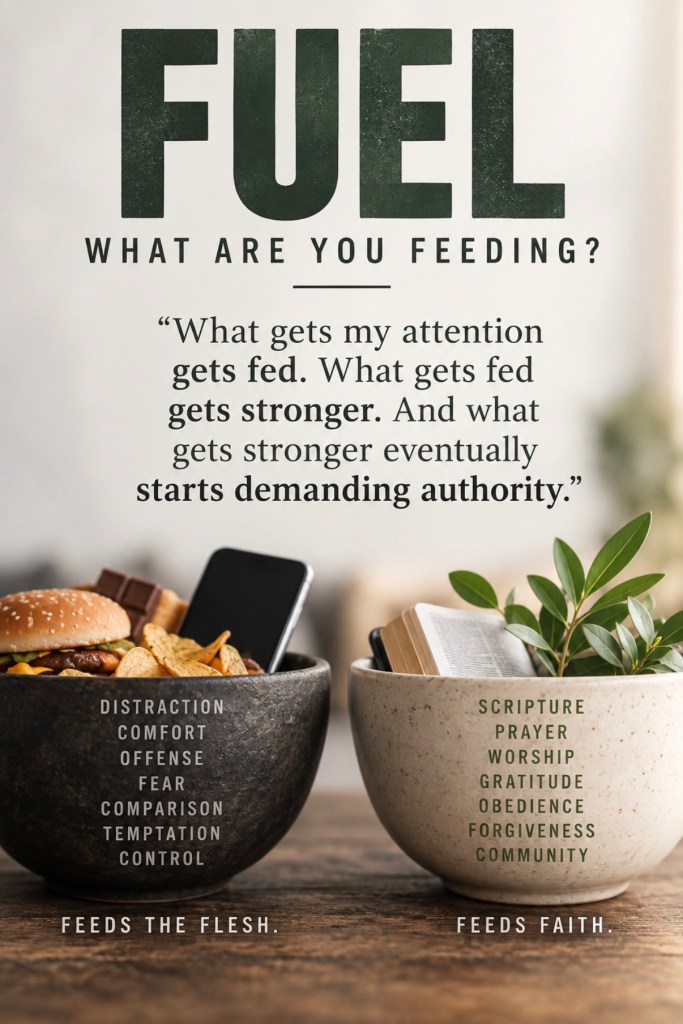
    Fuel for Holy Fire
    It begins in the quiet place.
    It begins with an open Bible.
    It begins on our knees.
    It begins when we stop talking long enough to listen to the God who has already spoken through His Word.
    If you’re waking up feeling more like ashes than fire today, maybe your answer isn’t trying harder.
    Maybe it’s preparing the altar.
    Open the Scriptures.
    Lay your worries, dreams, fears, and plans before your Father.
    Then wait with expectation.
    God has never asked His children to manufacture holy fire.
    He simply asks us to come, prepare the altar, and trust Him to provide what only He can.
    Prayer
    Father, forgive me for the times I rely on my own strength instead of seeking Yours. Teach me to begin each day by laying my life before You with an open heart and an open Bible. Replace my striving with surrender, my anxiety with expectancy, and my self-made sparks with the holy fire that comes only from Your presence. Amen.
    Your sister in Christ, Sunnye Anne☀️

    https://www.facebook.com/share/g/1HuoMp5pae/?mibextid=wwXIfr

    No comments on The Habit That Invites Holy Fire

    For more content or Christian fellowship check out https://www.facebook.com/share/g/1Ctxu31QKg/?mibextid=wwXIfr

  • When Road Rage Reveals Our Heart

    June 24, 2026
    Christian Faith

    Lately it feels like the roads are getting meaner.

    Headlines about road rage are everywhere, and it is no longer just statistics—it is personal. Last week on I-65, the same highway I usually drive home, a man was shot and injured in a road-rage incident. The same stretch of pavement I travel every day became the place where someone’s drive home nearly became their funeral.

    Closer to home, my mom was driving yesterday when her car began breaking down with my twin boys with her. The throttle failed, and she was simply trying to get safely off the road. You would hope that in a moment like that someone might stop and ask, “Are you okay? Do you need help?” Instead, a man rolled down his window, yelled at her to get off the road, and added a few obscenities for good measure.

    No compassion. No concern. Just anger.

    I wish I could say I have always responded differently.

    Not long ago, someone came flying up the shoulder on I-265 during rush-hour traffic and cut me off. In that split second I did not feel like offering grace. Something in me immediately flared up. The flesh was ready to take over. I did not quietly bless them in Jesus’ name. I hit the gas. I wanted to get around them. I wanted them to know exactly how wrong they were. It was a moment where I was no longer fighting the traffic but fighting my own nature.

    I did not make an obscene gesture, but the thought crossed my mind. For a brief moment, my heart was no different than the rest of the world—ready to defend my little square of asphalt, ready to answer frustration with frustration. Every time someone responds to anger with anger, we are adding another layer of stone to our hearts.

    When the Holy Spirit checked me in traffic and I actually listen, back off, breathe, and pray for the person, that is the heart of flesh in action, my heart. It’s the Holy Spirit at work replacing the fight with peace.

    He reminded me that I was not simply fighting traffic; I was fighting my own flesh. My soul settled, I backed off, and I continued home.

    That moment reminded me of something.

    The roads are simply exposing what is already beneath the surface.

    Impatience.

    Entitlement.

    Anger.

    The quiet belief that my time, my lane, and my agenda matter more than everyone else’s.

    Road rage may show itself through horns, hand gestures, yelling, and even violence, but underneath all of it lies something much deeper.

    This is not merely a traffic problem.

    It is a heart problem.

    Scripture tells us that battles like these are not solved by trying harder. They are spiritual battles. They are armor-of-God battles. They are moments where we desperately need Jesus to take hold of our hearts before our emotions take control of us.

    The truth is, some of us do not simply need better behavior.

    We need a heart transplant.

    God says in Ezekiel 36:26–27:

    “And I will give you a new heart, and a new spirit I will put within you. And I will remove the heart of stone from your flesh and give you a heart of flesh. And I will put my Spirit within you, and cause you to walk in my statutes and be careful to obey my rules.”

    Ezekiel 11:19 echoes the same promise:

    “I will remove the heart of stone from their flesh and give them a heart of flesh.”

    Notice what God is saying.

    He is not telling us to simply try harder.

    He is promising to do surgery we cannot perform on ourselves.

    If you are in a season where you feel hard, numb, angry, bitter, cynical, or simply worn down, that does not automatically mean you are disqualified. It may mean your heart is crying out for the Great Physician.

    That is where we have to ask ourselves some difficult questions.

    Am I drifting?

    Am I slipping back into old patterns?

    Am I allowing my heart to become harder one compromise at a time?

    Or am I willing to let the Lord put me on His operating table and deal with what I have been trying to hide?

    Pharaoh stands in Scripture as a warning.

    He repeatedly heard God’s voice, repeatedly witnessed God’s power, and repeatedly hardened his own heart. Eventually, God confirmed Pharaoh in the hardness he continually chose.

    Hebrews 3:15 warns us:

    “Today, if you hear his voice, do not harden your hearts.”

    I do not want that.

    You do not want that.

    None of us want to keep saying “no” until our hearts no longer recognize His voice.

    This is exactly why Paul tells us in Ephesians 6:10–13:

    “Be strong in the Lord and in the strength of his might. Put on the whole armor of God… For we do not wrestle against flesh and blood… Therefore take up the whole armor of God.”

    Our greatest battle is rarely the driver beside us.

    It is the war within us.

    One of the enemy’s favorite schemes is to slowly harden our hearts—to make bitterness feel normal, cynicism feel wise, and anger feel justified until we stop noticing how far we have drifted.

    But God offers something far better.

    He does not ask us to white-knuckle our way into becoming softer people.

    He says, “Let Me remove the heart of stone. Let Me give you a heart that can feel again. Let Me fill you with My Spirit so you actually desire to walk with Me.”

    Our responsibility is not to pretend the hardness is not there.

    Our responsibility is to surrender it.

    If you hear His voice today, do not ignore the warning light on the dashboard.

    Do not wait until your heart becomes comfortable with saying “no.”

    Instead, pray:

    “Lord, take this heart of stone. Give me a heart of flesh. Fill me with Your Spirit. Help me stand in Your strength instead of my own. Teach me to respond with the grace You have shown me—even in traffic.”

    Because the greatest danger on the road may not be the driver in the next lane.

    It may be the condition of our own hearts.

    Your sister in Christ Sunnye ☀️

    1 comment on When Road Rage Reveals Our Heart

    For more content or Christian fellowship check out https://www.facebook.com/share/g/1Ctxu31QKg/?mibextid=wwXIfr

  • Worship

    June 22, 2026
    Christian Faith
    Worship
    Our Worship Is How We Draw Near

    Worship is not merely something Christians do; worship is what we were created for.

    We were made to know God, enjoy God, glorify God, and grow in Him. Before we were workers, parents, spouses, friends, church members, or anything else, we were image-bearers created for fellowship with our Creator. God did not create us because He was lonely or lacked anything. He created us out of the overflow of His goodness and for the purpose of sharing Himself with us.

    From the opening pages of Genesis to the final chapters of Revelation, Scripture reveals a God who desires to dwell with His people. He walked with Adam and Eve in the garden. He dwelt among Israel in the tabernacle and temple. He came near through the incarnation of Christ. He indwells believers through the Holy Spirit. One day He will dwell with His people forever in the New Heavens and New Earth.

    The story of Scripture is, in many ways, the story of God drawing near.

    And worship is our response.

    Worship is not merely one Christian activity among many. It is the posture of a heart that recognizes God for who He is and responds accordingly. It is the continual movement of the soul toward its greatest treasure.

    Our Souls Long for God

    Many of us spend years chasing things we think will satisfy us. We pursue comfort, security, success, relationships, approval, entertainment, possessions, or achievements. Yet even after receiving those things, we often discover they cannot carry the weight of our deepest longings.

    Why?

    Because our souls were never designed to be satisfied by created things. We were created for the Creator.

    Augustine famously wrote, “You have made us for Yourself, and our hearts are restless until they rest in You.”

    David understood this longing:

    “As a deer pants for flowing streams, so pants my soul for you, O God.” (Psalm 42:1)

    “My soul thirsts for God, for the living God.” (Psalm 42:2)

    Again he writes:

    “O God, you are my God; earnestly I seek you; my soul thirsts for you; my flesh faints for you, as in a dry and weary land where there is no water.” (Psalm 63:1)

    The ache beneath every other ache is ultimately an ache for God Himself.

    We often think we need better circumstances when what we really need is deeper communion with God.

    We Become Like What We Worship

    Every person is a worshiper.

    The question is not whether we worship, but what we worship.

    Whatever captures our hearts shapes our lives. Whatever we treasure most eventually directs our thoughts, desires, decisions, and affections.

    This is why worship is so important. We become like what we behold.

    Paul writes:

    “And we all, with unveiled face, beholding the glory of the Lord, are being transformed into the same image from one degree of glory to another.” (2 Corinthians 3:18)

    The more we behold Christ, the more we become like Christ.

    The more we fix our eyes on His beauty, holiness, mercy, power, and grace, the more our hearts are transformed.

    Worship is not simply expressing love toward God. Worship is one of God’s primary means of changing us.

    Worship Builds Faith

    Faith was never meant to remain stagnant.

    Just as healthy children grow into maturity, believers are called to grow in grace, knowledge, obedience, and trust.

    Peter writes:

    “Grow in the grace and knowledge of our Lord and Savior Jesus Christ.” (2 Peter 3:18)

    How does that growth happen?

    One of God’s primary means is worship.

    Romans 10:17 tells us:

    “Faith comes from hearing, and hearing through the word of Christ.”

    Every time we pray, open Scripture, sing truth, repent of sin, obey God’s commands, serve others, or surrender our plans to Him, we are strengthening spiritual muscles.

    We are reminding our hearts:

    God is worthy.

    God is faithful.

    God is near.

    God is enough.

    And little by little, often in ways we cannot immediately see, God grows our faith.

    Worship Is Far More Than Music

    When people hear the word worship, they often think of music. Singing is certainly worship, but worship is much bigger than music.

    Jesus said:

    “You shall love the Lord your God with all your heart and with all your soul and with all your mind and with all your strength.” (Mark 12:30)

    Worship is a whole-life response to the worthiness of God.

    It involves our minds as we meditate on truth.

    It involves our hearts as we treasure Christ.

    It involves our wills as we obey Him.

    It involves our bodies as we serve Him.

    It involves our daily lives as we seek to glorify Him in everything.

    This is why Paul writes:

    “Present your bodies as a living sacrifice, holy and acceptable to God, which is your spiritual worship.” (Romans 12:1)

    Worship is not something we attend.

    Worship is a life we live.

    If the Stars Were Made to Worship

    One worship song says:

    “If the stars were made to worship, so will I.”

    That line resonates because it reflects biblical truth.

    Psalm 19:1 declares:

    “The heavens declare the glory of God, and the sky above proclaims his handiwork.”

    Creation itself is constantly pointing beyond itself to its Creator.

    The stars testify.

    The oceans testify.

    The mountains testify.

    The sunrise testifies.

    The seasons testify.

    All creation points to the glory of God.

    How much more should those who have been redeemed by the blood of Christ live lives of worship?

    The Goal of Worship

    The goal of worship is not performance.

    The goal of worship is not emotional hype.

    The goal of worship is not checking spiritual boxes.

    The goal of worship is communion with God.

    The goal is His presence.

    The goal is knowing Him more deeply, loving Him more fully, trusting Him more completely, and becoming more like Christ.

    Through worship, God renews our minds.

    Through worship, God strengthens our faith.

    Through worship, God exposes our idols.

    Through worship, God comforts our hearts.

    Through worship, God reminds us who He is.

    Through worship, God draws us closer to Himself.

    And perhaps that is the greatest gift worship offers us.

    Not better circumstances.

    Not easier lives.

    Not temporary relief.

    But God Himself.

    Because at the end of the day, what our souls have been searching for all along is not merely God’s gifts, but God.

    “Whom have I in heaven but you? And there is nothing on earth that I desire besides you.” (Psalm 73:25)

    Worship begins with recognizing who God is, but it does not end there. True worship moves us to know Him more deeply, enjoy Him more fully, glorify Him more faithfully, and grow in Him more completely.

    The more clearly we see His beauty, holiness, mercy, grace, and love, the more naturally our hearts respond in worship.

    And as we worship, we discover that drawing near to God was never about finding a distant God.

    It was about responding to the God who has been near all along.

    “For from him and through him and to him are all things. To him be glory forever. Amen.” (Romans 11:36)

    ☀️ Sunnye Anne

    No comments on Worship

    For more content or Christian fellowship check out https://www.facebook.com/share/g/1Ctxu31QKg/?mibextid=wwXIfr

  • – “Agapē in Motion: The Neighbor We Missed”

    June 21, 2026
    Christian Faith

    Many of you know this feeling.
    You’re driving, running late, your mind already on the next thing, and you see them standing on the corner. A cardboard sign. A weathered face. Someone’s son or daughter asking for help.
    Or maybe you’re walking into a store and there’s a person sitting outside with everything they own packed into a couple of bags.
    If you’re anything like me, your heart stirs for a moment… and then your mind starts making excuses.
    “They’re just lazy.”
    “They got themselves into this.”
    “If I give them money, they’ll just buy drugs or alcohol.”
    “It’s like that scene in Liar Liar when Jim Carrey finally blurts out to the beggar, ‘I’m not giving you money because I believe you’ll just buy booze with it.’ He simply says out loud what many of us quietly think.
    We convince ourselves that our indifference is wisdom. We call it being responsible or being a good steward.
    But it doesn’t stop at red lights.
    I see it all over social media:
    “We don’t need shelters here.”
    “If they’re homeless, they should go somewhere else.”
    “We don’t want that population in our community.”
    As if moving broken people away somehow moves sin away.
    The truth is that many of the people sleeping under bridges or walking our streets aren’t outsiders. They grew up here. They went to our schools. They played on our ball fields. They sat in our churches.
    They’re our neighbors.
    And yet we label them so we can keep our conscience clean.
    “They’re addicts.”
    “They’ll just waste it.”
    We act as though addiction, mental illness, or trauma somehow strips away a person’s worth.
    But Jesus never said,
    “I was hungry, and you fed Me—as long as I’d passed a drug test.”
    He simply said:
    “I was hungry… I was thirsty… I was a stranger… I was naked… I was sick… I was in prison.”
    No conditions. No qualifiers.
    I used to think driving past was neutral.
    “I didn’t hurt them. I just didn’t help.”
    But then I read Matthew 25
    Jesus says there will come a day when people stand before Him, and He says,
    “I was hungry and you gave Me no food. I was thirsty and you gave Me no drink. I was a stranger and you did not welcome Me.”
    And they’ll ask,
    “Lord, when did we see You?”
    And He answers,
    “As you did not do it to one of the least of these, you did not do it to Me.”
    That verse has haunted me.
    Because it means Jesus ties Himself to the very people I’m tempted not to see.
    Not long ago, God stopped letting this stay theoretical.
    Every morning on my way to work, I’d see the same woman walking along the road with a bag over her shoulder. Sometimes I’d hand her a blessing bag through my window and keep driving. I’d feel that little tug in my spirit, then drown it out with excuses.
    “I don’t have time.”
    “Somebody else will help.”
    “I don’t even know what to say.”
    One morning, I couldn’t shake it.
    It felt like the Holy Spirit was sitting in the passenger seat saying,
    “You’re not driving past her again.”
    So I pulled over.
    I got out of my car and walked up the hill toward her.
    I asked her name.
    She said, “Zoe.”
    Not “the homeless woman.”
    She has a name, Zoe.
    She told me she’d been raised by her grandparents, struggled with mental illness, lost the person she was living with, and was eventually evicted. Now she keeps her belongings in a storage unit and survives however she can.
    I don’t know every detail of her story.
    But I saw trauma.
    I saw loss.
    I saw someone without a safety net or support system.
    Then I really looked at her.
    Her eyes were the exact same color as my oldest daughter’s.
    In that moment, it hit me:
    She could have been my daughter.
    She is somebody’s daughter.
    She bears the image of God just as much as I do.
    Zoe told me she believed in God but had never really read the Scriptures for herself.
    So I gave her a Bible I had with me. I had marked passages about God’s love, provision, strength, forgiveness, and hope. I tucked some cash inside.
    When I handed it to her, she looked at me and asked,
    “Are you sure you want to give this to me?”
    I told her,
    “Yes. These verses all point back to Jesus. He knows your story, and He hasn’t forgotten you.”
    We talked about local resources and places she might find help.
    Before I left, I asked if there was anything else she needed.
    She looked at me and quietly said,
    “Could you just hug me?”
    So I did.
    And she hugged me back like she meant it.
    That hug didn’t solve everything.
    It didn’t erase her pain or instantly give her a home.
    But it reminded me what love actually looks like.
    Jesus didn’t just tell us to love our neighbors. He showed us.
    He touched lepers.
    He stopped for beggars.
    He washed dirty feet.
    The Greek word for that kind of love is agapē—a sacrificial, self-giving love that moves toward people instead of away from them.
    The same love that carried Christ to the cross.
    In Luke 10, when Jesus tells the story of the Good Samaritan, the religious people cross to the other side of the road.
    The Samaritan stops.
    He sees.
    He comes near.
    He bandages wounds.
    He gives his time, his money, and his comfort.
    Then Jesus says,
    “Go and do likewise.”
    Neighbor isn’t just the person who lives next door.
    Neighbor is whoever God places in front of you.
    The man with the cardboard sign.
    The woman walking the roadside.
    The addict.
    The broken.
    The forgotten.
    The question isn’t whether they’re our neighbor.
    Jesus already answered that.
    The real question is whether we’ll cross to the other side to protect our comfort—or whether we’ll come near and show mercy.
    Because somewhere in all of this, I think Jesus is still whispering:
    “Whatever you did for one of the least of these brothers and sisters of Mine, you did for Me.”
    “So when that moment comes—the stoplight, the parking lot, the person on the corner—we’re not just deciding what to do with them. Are we practicing Agapē in Motion? ☀️ Sunnye

    No comments on – “Agapē in Motion: The Neighbor We Missed”

    For more content or Christian fellowship check out https://www.facebook.com/share/g/1Ctxu31QKg/?mibextid=wwXIfr

  • “I’m Yours as I Sleep: Childlike Prayers to Combat Sleepless Nights (The Father’s Arms Are Never Too Far Away)”

    June 21, 2026
    Christian Faith

    I am someone who has lived with chronic illness for most of my life. Some nights sleep comes easily and early. Other nights, my mind and body simply refuse to shut off. Pain lingers, thoughts race, and rest feels just out of reach. Over the years, those long nights have taught me something precious about the heart of God.

    I’m a daddy’s girl, so I know the comfort of being able to crawl into my father’s arms and know I was safe. As a little girl, I remember climbing into my dad’s lap, tucking my head beneath his chin, and feeling his arms wrap all the way around me. The world could be loud, the house could be busy, and life could feel overwhelming, but in that spot everything became small and quiet. I didn’t have to explain why I was tired, scared, or sad. I didn’t have to have the right words. I just rested there, knowing I was loved and protected.

    That is the picture I carry when I think about my Father in heaven.

    But when I come to my Father in heaven, it goes even deeper. I am my Father’s daughter.

    He doesn’t just see my face and hear my words; He sees everything. He sees the mess, the pain, the frustration, and the anger. He sees the memories I don’t talk about and the disappointments I can’t even put into words. He sees the places in me that are wounded so deeply that language fails. Psalm 139 tells us that He searches me and knows me, that He discerns my thoughts from afar, and that before a word is on my tongue, He knows it completely.

    God doesn’t get impatient with me there. He isn’t frustrated that I’m not praying better or that I don’t have the perfect words. He meets me exactly where I am.

    Yes, there are times when prayer should be fervent, alert, and intentional. But there is also something beautiful about reaching the end of a long day, after the prayers have been prayed and the thanksgiving has been offered, and simply drawing near to Him.

    Sometimes my prayer becomes nothing more than, “Daddy… Father in heaven… can I just be with You now?”

    And He never tells me no.

    He never tells me now is not the time.

    He welcomes me.

    What follows is one of the purest acts of worship I know: surrender.

    Not a surrender of defeat, but a surrender of trust. Open hands. Open heart. A willingness to place every part of myself into His care.

    Full surrender is yielding every part of yourself to God—your plans, fears, desires, pain, future, relationships, successes, failures, and even your understanding—while trusting Him to lead and care for you. It is not giving up; it is giving over.

    Full surrender says:

    “God, Your will is more important than mine.”

    “I trust You even when I don’t understand.”

    “My life belongs to You, not me.”

    “I will obey even when it is uncomfortable.”

    “I release my need to control the outcome.”

    Full surrender doesn’t mean I never struggle. It doesn’t mean I never ask questions, feel afraid, or experience pain. It means that in the middle of those things, I continue placing myself into God’s hands.

    For someone living with chronic illness, surrender often sounds like this:

    “Father, I don’t understand why my body hurts. I wish things were different. But whether You heal me today, tomorrow, or in eternity, I belong to You. My life is Yours. My suffering is Yours. My future is Yours. I trust You with what I cannot carry.”

    Then I simply whisper:

    “God, I’m Yours. I’m Yours while I sleep. If there is something in my heart that still needs to be spoken, something that needs to be brought before You, use it. Use my dreams. Use my breathing. Use this quiet moment. Here is all of me. Do with me what You will.”

    That is the posture of a child climbing into her Father’s lap and saying:

    “I don’t have all the answers. I don’t know how this story ends. But I know You. So I will rest in Your arms and trust You with all of me.”

    This is what childlike faith looks like.

    Jesus said in Matthew 18:3, “Truly I tell you, unless you turn and become like little children, you will never enter the kingdom of heaven.”

    Little children don’t overanalyze their father’s love. They don’t strive to earn their place in his arms. They simply climb up, lean in, and trust that they are safe. That is the posture God invites us into.

    And on the nights when I can’t find the words—when pain is overwhelming, exhaustion has taken over, or my heart is simply too heavy—Romans 8:26-27 brings incredible comfort:

    “The Spirit helps us in our weakness… the Spirit himself intercedes for us through wordless groans.”

    Even when my mouth is silent, heaven is not.

    The Holy Spirit carries every burden, every fear, every tear, and every unspoken prayer to the Father who already knows. He intercedes when I can’t. He prays when I have no strength left.

    So when I finally lay down at night, I picture myself curling up in the lap of my Father. Psalm 4:8 says:

    “In peace I will lie down and sleep, for you alone, Lord, make me dwell in safety.”

    I am not merely collapsing from exhaustion. I am surrendering myself into His care. I am placing every burden, every ache, every unanswered question, and every fear into His hands. I am allowing Him to hold the parts of me that are too heavy to carry one more step.

    And I rest knowing that the same God who sustained me throughout the day is watching over me through the night. He guards my mind, comforts my heart, and sings over me as I sleep. Even my breathing becomes an expression of trust.

    Because I am His daughter.

    And I am safe in my Father’s arms.

    Love your sister in Christ, ☀️Sunnye

    No comments on “I’m Yours as I Sleep: Childlike Prayers to Combat Sleepless Nights (The Father’s Arms Are Never Too Far Away)”

    For more content or Christian fellowship check out https://www.facebook.com/share/g/1Ctxu31QKg/?mibextid=wwXIfr

1 2
Next Page

Website Built with WordPress.com.

Holy Moments in a Worn‑Out Life: Time Well Spent Turning Back to the Word

A worn-out body, a cracked world, and a faithful Savior who loves my soul. 🔆Sunnye Anne

    • 911 EMERGENCY SCRIPTURES – When you don’t know where else to turn, start here.
    • About me
    • Men of Faith of the Bible… Case Study: Daniel
    • Men of Faith of the Bible… Case Study: David
    • Men of Faith of the Bible… Case Study: Paul formerly Saul
    • Women of the Bible… Case Study: Esther
    • Women of the Bible… Case Study: Hagar
    • Women of the Bible… Case Study: Rahab
    • Women of the Bible… Case Study: Ruth
    • Women of the Bible… Case Study: Sarah
Loading Comments...
  • Subscribe Subscribed
    • Holy Moments in a Worn‑Out Life: Time Well Spent Turning Back to the Word
    • Already have a WordPress.com account? Log in now.
    • Holy Moments in a Worn‑Out Life: Time Well Spent Turning Back to the Word
    • Subscribe Subscribed
    • Sign up
    • Log in
    • Report this content
    • View site in Reader
    • Manage subscriptions
    • Collapse this bar