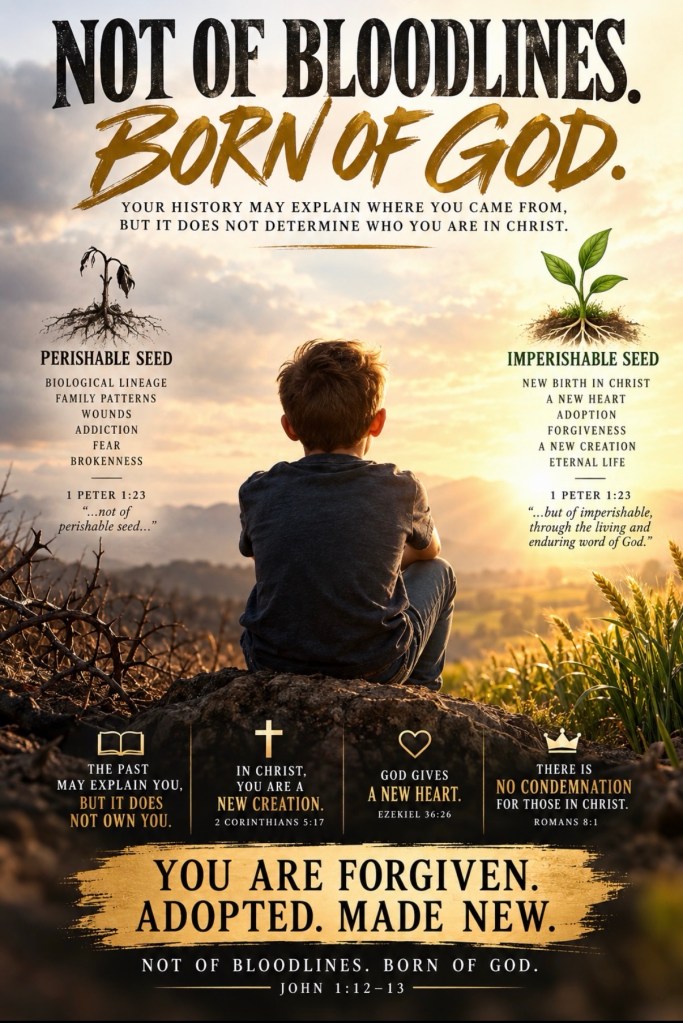
Not of Bloodlines. Born of God.
Your history may explain where you came from, but it does not determine who you are in Christ.
The other day, right after he turned ten, one of my boys decided he was trouble.
Not because he had done something terrible. Not because someone had caught him doing something wrong. But because somewhere in that little mind of his, he had begun connecting the dots of a story he never asked to be part of.
His biological parents had been in and out of jail. Addiction had been part of their story. And in his ten-year-old understanding of the world, he had reached a conclusion that absolutely broke my heart.
If I came from them, I must be like them.
Ten years old.
Ten years old, and already carrying the weight of choices he never made. Already looking backward at a history he had no control over and allowing it to tell him something about his future.
And isn’t that exactly what so many of us do?
We look at where we came from, what we have experienced, what our parents struggled with, what generations before us battled, and somewhere along the way, we begin confusing our history with our identity.
We start believing that because something runs in the family, it must run our lives.
Because our father struggled with addiction, we will too. Because our mother lived in fear, we will never know peace. Because anger, abandonment, dysfunction, poverty, or broken relationships have traveled through generations, we assume they have already reserved a place in ours.
Sometimes we don’t even realize we have accepted the lie. We simply begin living as though the ending has already been written.
But here is what I desperately want my boy to understand, and what I think some of us grown adults still need to hear:
Inherited is not the same as inevitable.
And the bloodline you came from does not have the authority to determine who you become.
The Seed You Came From Is Not the End of Your Story
John opens his Gospel with a declaration that we can read right past if we aren’t paying attention.
“But as many as received him, to them gave he power to become the sons of God, even to them that believe on his name: Which were born, not of blood, nor of the will of the flesh, nor of the will of man, but of God.” — John 1:12–13 (KJV)
Not of blood.
Not of human determination.
Not of somebody else’s choices.
But of God.
John is describing a birth that human ancestry cannot produce. The right to become God’s children comes through receiving Christ, not through having the right family, the right upbringing, or the right last name.
And then Peter takes this truth somewhere even deeper.
“Being born again, not of corruptible seed, but of incorruptible, by the word of God, which liveth and abideth for ever.” — 1 Peter 1:23 (KJV)
The Greek word translated born again is ἀναγεγεννημένοι (anagegennēmenoi), from anagennaō, meaning to be begotten or born anew.
But it is the word for seed that caught my attention.
σπορά (spora) — Strong’s G4701.
It refers to sowing or seed, and in this context carries the idea of the source from which life is generated.
Think about that.
A farmer understands something about seed that we sometimes forget when it comes to our own lives.
What is planted matters.
You don’t plant wheat and expect an apple tree. You don’t scatter corn into the soil and expect roses to bloom. The nature of the seed determines the kind of life it produces.
And Peter is drawing a breathtaking distinction between two kinds of seed.
One is perishable.
The other is imperishable.
The word for perishable is related to φθαρτός (phthartos) — corruptible, subject to decay, temporary.
The word for imperishable is ἄφθαρτος (aphthartos) — incorruptible, not subject to decay.
Our natural birth gives us mortal life. We inherit a human history, a family story, and a nature touched by the brokenness of this world.
But through Christ, we are given something that human ancestry could never supply.
A new birth.
An eternal life grounded in the living and enduring Word of God.
I sat with that thought and kept coming back to my boy.
He had been looking at the first seed, the biological history that brought him into this world, and assuming it determined everything that could ever grow from his life.
But that is not the whole story.
His first birth tells us where his earthly life began. His new birth in Christ tells us to whom he belongs forever.
And those are not the same thing.
Peter doesn’t even leave room for us to misunderstand. Immediately after speaking of perishable and imperishable seed, he quotes Isaiah 40.
“For all flesh is as grass, and all the glory of man as the flower of grass. The grass withereth, and the flower thereof falleth away: But the word of the Lord endureth for ever.” — 1 Peter 1:24–25 (KJV)
Grass withers.
Flowers fall.
Human strength fades.
Earthly legacies eventually pass away.
But God’s Word does not.
The things that seem so permanent to us—the labels, the family reputation, the failures, the patterns that have lasted for generations—are not more enduring than the promises of God.
The first birth is not the final word for someone who has been born again.
A Family Pattern Is Not a Life Sentence
Now, I want to be careful here, because I don’t believe we do anyone a favor by pretending family history doesn’t matter.
It does.
Children raised around addiction, instability, abuse, neglect, or abandonment can carry wounds they didn’t choose. Trauma can shape how we respond to conflict, how we trust people, how we see ourselves, and even what feels normal to us.
Some of those patterns become so deeply ingrained that we don’t recognize them until we see ourselves repeating something we once promised we never would.
And some struggles involve real biological vulnerabilities, including inherited risks for addiction and mental health conditions.
Those things are real.
Faith does not require us to deny them.
But there is a difference between acknowledging a vulnerability and surrendering our identity to it.
There is a difference between saying, This is something I may need to be mindful of, and saying, This is all I will ever be.
One is wisdom.
The other is a prison.
And sometimes the prison isn’t built by what anyone else says about us. Sometimes we build it ourselves, brick by brick, with the conclusions we have drawn about our own past.
God addressed this kind of thinking through the prophet Ezekiel.
In Ezekiel 18, the people repeated a proverb:
“The fathers have eaten sour grapes, and the children’s teeth are set on edge.” — Ezekiel 18:2 (KJV)
In other words, the parents made the choices, but the children were destined to bear the consequences.
God challenged their fatalism. He made it clear that a person was not automatically guilty of a parent’s sins. Each generation was responsible for its own response to Him.
That doesn’t mean the consequences of someone else’s choices never touch us. We know they do.
But it means another person’s sin does not become our moral identity simply because we share their DNA.
My boy may have inherited certain vulnerabilities.
He may have questions about his biological family that I cannot answer.
He may someday have to confront struggles connected to a history he never chose.
But he is not guilty of his parents’ choices.
He is not destined to repeat their mistakes.
And he is certainly not trouble simply because trouble existed before he was born.
God Doesn’t Just Repair What Was Broken
This is where the gospel becomes so much more than a message about trying harder to be a better person.
Paul writes:
“Therefore if any man be in Christ, he is a new creature: old things are passed away; behold, all things are become new.” — 2 Corinthians 5:17 (KJV)
The Greek word translated new is καινός (kainos).
It speaks of something new in quality or kind, not merely something that has been cleaned up on the outside.
That distinction matters.
Because so much of our effort goes into trying to make the old life look better.
We manage our behavior.
We hide our struggles.
We polish our image.
We try desperately not to become the people who hurt us.
And while changing our behavior matters, the gospel reaches much deeper than behavior modification.
God doesn’t simply hand us a better set of rules and tell us to try again.
He gives us new life.
In Ezekiel 36:26, God promises:
“A new heart also will I give you, and a new spirit will I put within you.”
Notice who is doing the work.
I will give.
I will put.
God is not asking us to manufacture a new heart out of the broken pieces of the old one.
He is promising to do what we cannot do for ourselves.
That doesn’t mean every wound disappears the moment we come to Christ. It doesn’t mean temptation vanishes, memories are erased, or years of learned survival patterns suddenly untangle themselves.
Sanctification is often a long, humbling process.
Sometimes healing involves prayer, repentance, counseling, accountability, boundaries, and learning entirely new ways of responding to life.
Sometimes the Lord exposes a pattern in us that has been passed down for generations, and we have to make a daily decision not to feed it anymore.
But we are no longer fighting for a new identity.
We are learning to live from the identity Christ has already given us.
That changes everything.
You Are Not Disqualified by Where You Started
I think one of the enemy’s most effective lies is convincing people that their beginnings have already disqualified them from anything God could possibly want to do with their lives.
We look at our family history and think, God could never use someone who came from this.
We look at our own mistakes and think, I’ve already ruined too much.
We look at the people around us who seem to have come from stable families, loving homes, and beautiful Christian upbringings, and we quietly assume they have some advantage in the kingdom of God that we will never possess.
But have we actually read the people God used?
David was the shepherd boy who wasn’t initially brought forward when Samuel came looking for a king.
Gideon was hiding when God called him a mighty man of valor.
Moses argued that he wasn’t capable of speaking the way God needed him to.
Jeremiah thought he was too young.
And Paul?
Paul had a history of persecuting the very people who followed the Christ he would eventually proclaim.
He never pretended his past didn’t exist.
He acknowledged it.
But he also refused to let it become greater than God’s grace.
“But by the grace of God I am what I am.” — 1 Corinthians 15:10 (KJV)
I love that.
Not by my family name.
Not by my reputation.
Not by what I inherited.
Not by what I did before I knew Him.
By the grace of God, I am what I am.
God has never required an impressive pedigree to accomplish His purposes.
In fact, Scripture repeatedly shows Him working through the overlooked, the weak, the unlikely, and the people the world would have dismissed.
Not because their histories didn’t matter.
But because His power was never dependent upon their histories being perfect.
The Father Who Gets to Name You
There is another piece of this that I cannot get away from.
Adoption.
Romans 8:15 tells us:
“For ye have not received the spirit of bondage again to fear; but ye have received the Spirit of adoption, whereby we cry, Abba, Father.” (KJV)
That word adoption carries such weight.
Because adoption is not simply being allowed into someone’s house.
It is being welcomed into a family.
It is belonging.
It is being given the standing of a son or daughter.
And in Christ, we are not merely tolerated by God.
We are received.
We are loved.
We are made His children.
I think about my boy and the questions that must sometimes run through his mind.
Who am I like?
Where did I come from?
What does my family history mean about me?
Will I turn out the same way?
And I wish I could reach inside his little heart and remove every ounce of fear attached to those questions.
I can’t.
I cannot rewrite his beginning.
I cannot undo what happened before he came into our lives.
I cannot promise that every hard thing connected to his history will be easy to overcome.
But I can tell him the truth.
His biological parents’ struggles do not define his character.
Their mistakes are not his guilt.
Their history is not his destiny.
And the circumstances surrounding his birth have never made him less worthy of love.
I can remind him that he is responsible for the choices he makes, not the choices someone else made before him.
And most importantly, I can point him to the Father whose love is not determined by genetics, human failure, or family reputation.
The Father who does not look at a child and say, I know where you came from, so I know what you’ll become.
But who calls His children by name and invites them to walk in the new life He has given them.
What Are We Still Allowing to Name Us?
And maybe that is the question for the rest of us.
Because this isn’t just about a ten-year-old boy.
How many of us are still allowing something from our past to introduce us before Christ ever gets a word in?
We say:
I’m just like my mother.
That’s the temper I inherited from my father.
Addiction runs in my family.
We have never had healthy marriages.
Nobody in my family ever gets ahead.
This is just how we are.
Sometimes those statements begin as observations.
But somewhere along the way, we turn them into declarations.
We stop describing what has happened and start declaring what must happen next.
And then we wonder why we keep walking in circles.
Scripture tells us to be transformed by the renewing of our minds (Romans 12:2).
That means we must begin examining the things we have accepted as truth.
Not every thought that feels familiar is true.
Not every family pattern deserves to continue.
Not every label spoken over us belongs to us.
And not every voice that shaped our childhood deserves authority over our adulthood.
Some of us need to stop rehearsing the identity our past gave us and begin believing what God has said about us.
Romans 8:1 says there is no condemnation for those who are in Christ Jesus.
Ephesians 2:10 says we are His workmanship, created in Christ Jesus for good works.
Galatians 3:13 tells us Christ redeemed us from the curse of the law.
And John 1 reminds us that those who receive Him are born of God.
Not of blood.
Not of human will.
But of God.
That is not a denial of our earthly story.
It is the declaration that our earthly story is not the highest authority over our lives.
The Story Isn’t Finished
I don’t know every chapter my boy will write.
I don’t know what challenges he will face, what questions he will ask, or what battles he may have to fight as he grows older.
But I know I never want him to mistake where he came from for who he is.
I want him to understand that he can love his biological parents without repeating their choices.
He can acknowledge their struggles without carrying their guilt.
He can recognize the brokenness in his family history without believing he himself is broken beyond repair.
And he can grow into a man whose life looks entirely different from the patterns that came before him.
Not because he has better blood.
Not because he is strong enough to overcome everything on his own.
But because God’s grace is greater than the story that came before him.
And that is true for us too.
Maybe your history doesn’t include addiction or jail cells.
Maybe it includes generations of bitterness, pride, unforgiveness, abuse, fear, emotional distance, or people who simply never knew how to love well.
Maybe you have spent your whole life trying not to become someone else.
Or maybe you have already repeated some of the very things you swore you never would.
The gospel still speaks.
There is forgiveness.
There is repentance.
There is restoration.
There is new life.
And there is a Father who is not intimidated by the family tree behind you.
Your history may explain some of your wounds, but it does not get to write the final chapter of your identity.
For those who belong to Christ, the old life no longer has the final claim.
And for those who have not yet received Him, that invitation to new life is still open.
I keep thinking about that little ten-year-old boy, trying to make sense of a story far too heavy for his shoulders.
And I keep coming back to one simple truth I want him to carry for the rest of his life.
You are not trouble because trouble came before you.
You are not the sum of somebody else’s mistakes.
You are not a prediction based on your parents’ worst moments.
And you are not destined to become what hurt you.
The past is part of your story.
But it does not have to be the pattern of your future.
Because in Christ, we are not merely what happened to us.
We are forgiven.
We are adopted.
We are made new.
And when the world, our memories, or even our own thoughts try to tell us that our bloodline has already decided who we are, we can return to the words of John.
Not of bloodlines.
Born of God.
And that is a far greater inheritance than anything this world could ever pass down.


Leave a Reply