- What does their name mean and where do we first meet them in Scripture?
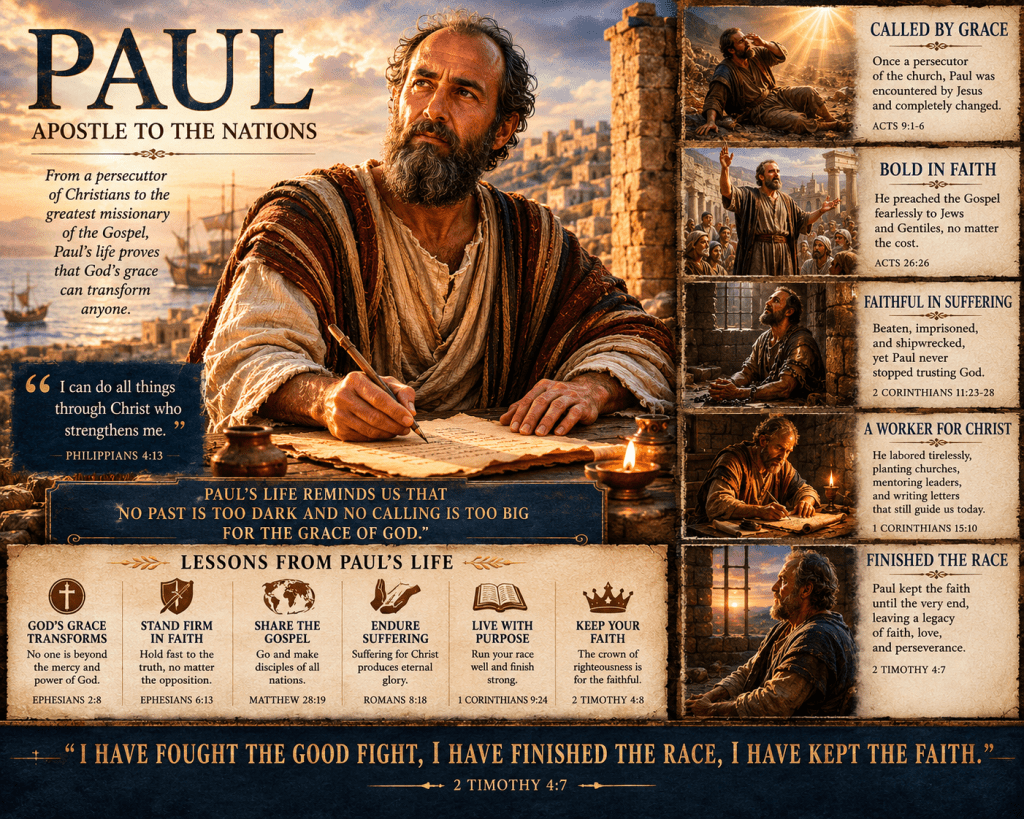
Saul’s Hebrew name (Sha’ul) means “asked for” or “prayed for.” His Roman/Greek name is Paul (Paulos), likely meaning “small” or “little.” We first meet him as Saul in Acts 7:58–8:3, guarding the coats while Stephen is stoned and “ravaging the church,” dragging men and women off to prison. - What is the historical and biblical context of their story?
Paul lives in the days after Jesus’ death, resurrection, and ascension, during the early growth of the church under Roman rule. The gospel is starting in Jerusalem and pushing outward to Judea, Samaria, and the ends of the earth (Acts 1:8). There is real persecution, strong Jewish opposition, and big questions about how Gentiles fit into God’s people. Paul’s life sits right in the middle of that tension. - What are the key relationships in their life?
Key people: the risen Jesus, who literally stops him on the road; Ananias, who obeys God and goes to pray for the former persecutor; Barnabas, who vouches for Paul when everyone is scared of him and later travels with him; co-laborers like Silas, Timothy, Luke, Priscilla and Aquila; and opponents like the unbelieving Jewish leaders and Roman officials who arrest and beat him. The churches he plants (Corinth, Galatia, Philippi, Ephesus, etc.) also become deep heart-relationships—he calls them his joy, crown, and even his “little children” in the faith. - What is their main turning point or crisis moment in the story?
The huge turning point is Acts 9 on the road to Damascus. Saul is literally on his way to arrest Christians when a light from heaven flashes, he falls to the ground, and hears Jesus say, “Saul, Saul, why are you persecuting Me?” That encounter blinds him and stops his whole life trajectory. - How do they respond to God in that moment?
Saul’s first response is submission and a question: “Who are You, Lord?” and then “What shall I do, Lord?” (Acts 9; 22:10). He allows himself to be led blind into Damascus, fasts for three days, and receives Ananias’s prayer, sight, and baptism. From that point, he pivots hard—almost immediately preaching that Jesus is the Son of God, and over time becoming the apostle to the Gentiles, pouring out his life for the same gospel he once tried to destroy. - What does God reveal about Himself in their story?
In Paul, we see that God is sovereign enough to interrupt anyone’s plans, even an enemy. God shows His mercy, calling the “worst” kind of sinner—violent, religiously proud, convinced he is right—and turning him into a trophy of grace (1 Timothy 1:12–16). We see God’s patience with the church too, teaching them to accept someone they deeply feared, and His power to use suffering, imprisonment, and weakness as the actual vehicle for spreading the gospel. - How does this person point forward to Jesus or connect to the bigger redemption story?
Paul doesn’t point forward to Jesus; he points back to Him and explains what Jesus has done. Through Paul’s letters, we get so much of our core theology: justification by faith, union with Christ, adoption, the body of Christ, spiritual gifts, the armor of God, resurrection hope. His life becomes a living example of the new covenant—someone who was zealous for the law but finds true righteousness only in Christ (Philippians 3). - Where do we see their humanity and weakness?
We see Paul’s humanity in his thorn in the flesh (2 Corinthians 12), his physical weakness, his fear and trembling (1 Corinthians 2:3), his conflicts with others (like Barnabas over Mark in Acts 15), and his deep emotional burden for the churches. He doesn’t pretend to be perfect—he calls himself the chief of sinners and admits he hasn’t “already obtained” perfection but is pressing on (Philippians 3:12–14). - What does their story teach us about following God in our own “right now” life?
Paul’s story tells you that nobody is too far gone and that God can completely reroute a life in a moment. It shows that obedience may mean suffering, misunderstanding, and weakness instead of comfort and applause, but that joy and purpose are found in belonging to Christ. It pushes us to hold truth and love together—calling out false teaching, building up the church, and being willing to spend and be spent for others because Jesus is worth it. - What are one or two key Scriptures (with references) that summarize their story or theme?
Acts 9:15–16 – “But the Lord said to him, ‘Go, for he is a chosen instrument of Mine, to carry My name before the Gentiles and kings and the children of Israel. For I will show him how much he must suffer for the sake of My name.’”
1 Timothy 1:15–16 – “Christ Jesus came into the world to save sinners—of whom I am the foremost. But I received mercy for this reason, that in me, as the foremost, Jesus Christ might display His perfect patience…”