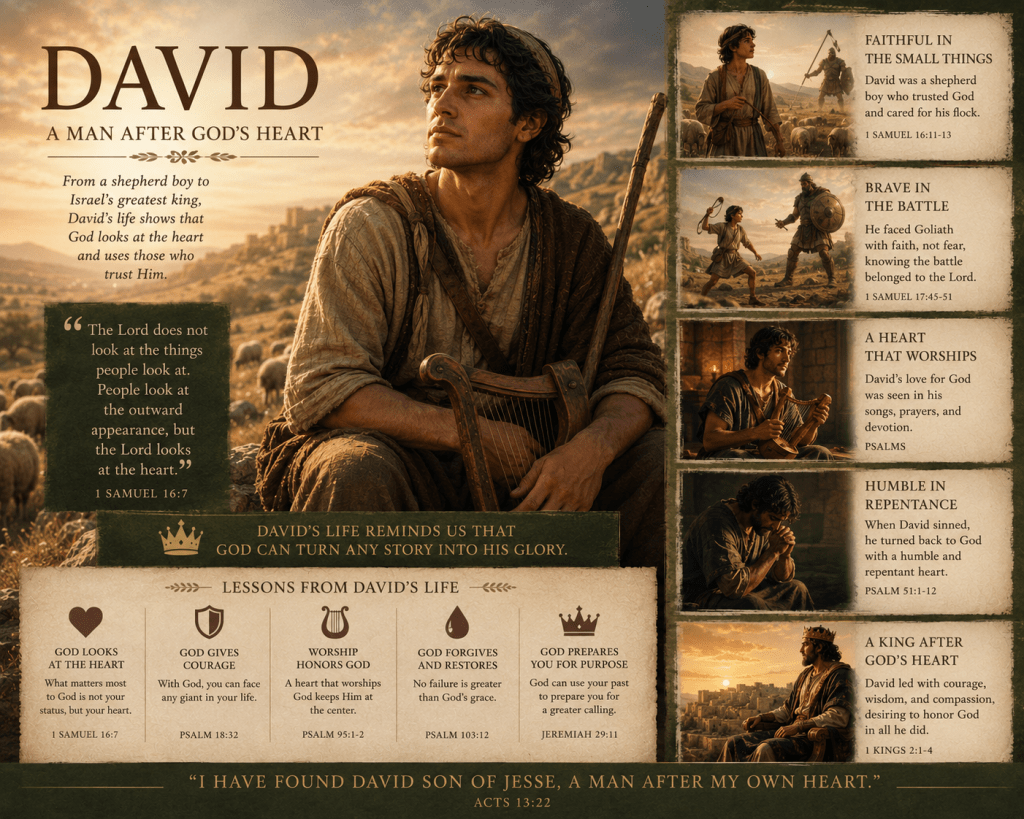
Who David is and where he shows up: David’s name in Hebrew (Dawid) is often connected to the idea of “beloved.” He is the youngest son of Jesse, a shepherd from Bethlehem in Judah, anointed by the prophet Samuel while Saul is still king (1 Samuel 16). We meet him first as the overlooked little brother out with the sheep, then as a harp player in Saul’s court, an armor-bearer, a giant-slayer, a military leader, a fugitive, and finally the second king of Israel who reigns over a united kingdom (1–2 Samuel, 1 Chronicles). His story stretches from obscurity in the fields to the throne in Jerusalem, and then into deep failure, discipline, and restoration.
Key relationships and turning points: David’s life is marked by a few core relationships: Samuel, who anoints him; Saul, the first king who grows jealous and hunts him; Jonathan, Saul’s son and David’s covenant friend; Michal, his first wife; Bathsheba and Uriah, whose story exposes David’s darkest sin; and Nathan the prophet, who confronts him (2 Samuel 12). A massive early turning point is his victory over Goliath in 1 Samuel 17, where he steps out not in his own strength but in the name of “the LORD of hosts” and shows that God saves “not with sword and spear.” Another turning point is his years of running from Saul, refusing to kill the king even when he has the chance, choosing to honor God’s anointing instead of grabbing power (1 Samuel 24, 26). The most sobering turning point is his sin with Bathsheba—adultery, deception, and arranging Uriah’s death—followed by Nathan’s parable, David’s confession, and the consequences that ripple through his family (2 Samuel 11–12).
“A man after God’s own heart” doesn’t mean perfect: When Scripture calls David “a man after God’s own heart” (1 Samuel 13:14; Acts 13:22), it’s not sanitizing him; it’s highlighting his response to God. David sins big, but he also repents big. Psalm 51 shows his broken, honest confession after Nathan confronts him—no excuses, no blame-shifting, just “Against you, you only, have I sinned.” We see in the Psalms a man who brings everything to God: fear, anger, worship, questions, joy. David trusts God’s character when he’s on the run in caves, when he’s betrayed, and when he’s being disciplined. He keeps coming back to God instead of running away in pride or hardening his heart.
Covenant, kingship, and the promise: In 2 Samuel 7, God makes a covenant with David that becomes one of the core backbone promises of the whole Bible: God will establish David’s throne forever and raise up a descendant whose kingdom will not end. David is a flawed king, but his line is where the Messiah will come from. The prophets and the New Testament keep reaching back to this: Jesus is called the Son of David, born in Bethlehem, the city of David (Micah 5:2; Luke 2:4). David’s reign, with its victories and its failures, becomes a pattern and a contrast—every other king is measured against him, and yet everyone falls short, pointing us forward to a better King who will rule in perfect righteousness.
How David points to Jesus and to us: David is a shadow of the true Shepherd-King. As a shepherd who fights lions and bears to protect his flock, he pictures Jesus, the Good Shepherd who lays down His life for the sheep (John 10). As a warrior who defeats Israel’s enemy when everyone else is afraid, he pictures Christ defeating our greater Goliaths of sin, death, and Satan. But David’s sin also makes it crystal clear that no human leader, no matter how “after God’s heart,” can carry the weight of being our Savior. His story gives hope for people who have blown it badly—that real repentance is possible, that God can restore and still use broken people, and that God’s promises don’t rest on our perfection but on His faithfulness. David invites us to be people after God’s own heart too: quick to repent, honest in prayer, willing to trust God’s timing, and content to let God exalt us or keep us low according to His will.