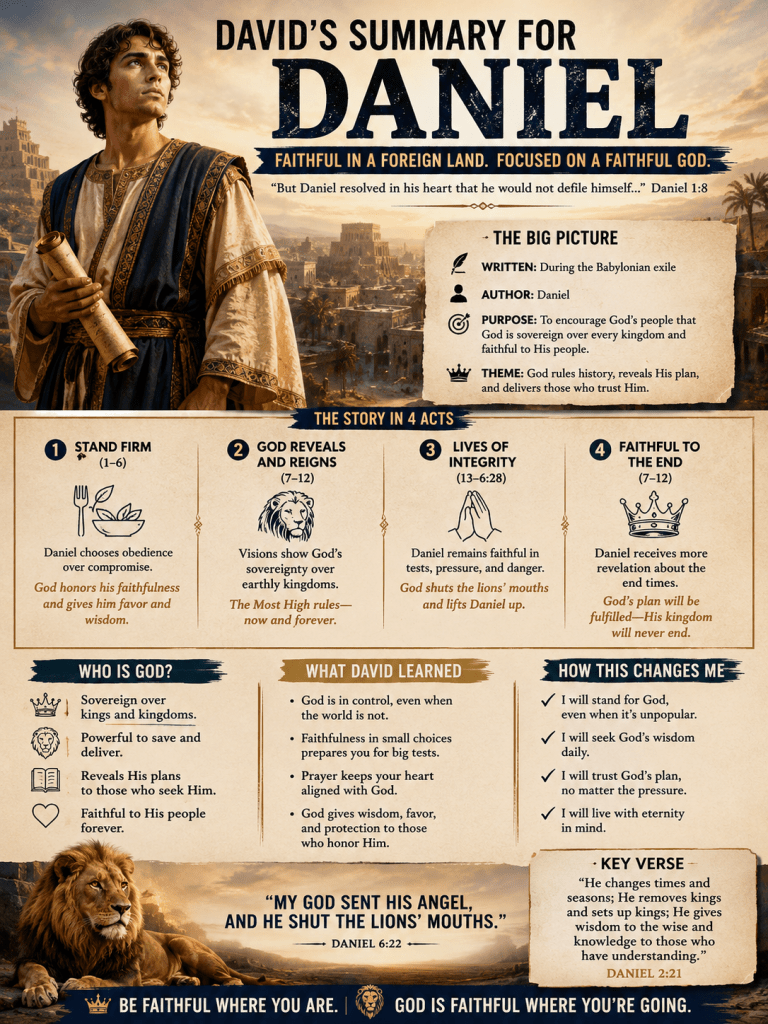
- Who is Daniel?
Daniel is a young Jewish exile taken to Babylon, likely of noble or royal family, who is renamed Belteshazzar but refuses to let Babylon rename his heart. He becomes a trusted administrator and prophetic voice under multiple pagan kings (Nebuchadnezzar, Belshazzar, Darius, Cyrus). He’s the guy who stays faithful in a hostile system without becoming that system.
- Where does Daniel show up in Scripture?
Primarily in the book that bears his name, Daniel 1–12. He’s also indirectly referenced in Ezekiel 14:14, 20 and Ezekiel 28:3 as an example of righteousness and wisdom. Jesus refers to “Daniel the prophet” in Matthew 24:15.
- What is the cultural and historical setting?
Daniel is set during the Babylonian exile, starting around 605 BC when Judah’s elite are taken captive. God’s judgment has fallen on His people for their idolatry, and they are living as strangers in a powerful, pagan empire obsessed with power, image, and false gods. Daniel has to navigate pagan education, food, politics, and idolatry while still belonging to Yahweh.
- What are the key events in Daniel’s story?
1) Daniel 1 – Taken into Babylonian training, he resolves not to defile himself with the king’s food and God honors his faithfulness.
2) Daniel 2 – God gives him the dream and interpretation of Nebuchadnezzar’s statue when all the wise men are about to be killed.
3) Daniel 3 – His friends Shadrach, Meshach, and Abednego refuse to bow to the golden image and are delivered from the fiery furnace.
4) Daniel 4 – Daniel interprets Nebuchadnezzar’s second dream and warns him to repent before he’s humbled like a beast.
5) Daniel 5 – Daniel reads the writing on the wall for Belshazzar the night Babylon falls.
6) Daniel 6 – Daniel continues praying despite the law and is thrown into the lions’ den, but God shuts the lions’ mouths.
7) Daniel 7–12 – He receives apocalyptic visions about future kingdoms, the “Ancient of Days,” the “Son of Man,” persecution, and final deliverance.
- What are the main character traits of Daniel?
He is resolute: he “purposed in his heart” not to defile himself (Daniel 1:8). He is wise and tactful, able to make counter‑cultural stands without being reckless or rude. He is prayerful and disciplined, praying three times a day even when it becomes illegal. He is courageous, willing to face death rather than compromise. He is humble: he always gives God credit for wisdom and revelation. - How does Daniel respond to God?
Daniel treats God as Lord in a foreign land, not just in Jerusalem. He seeks God for mercy and revelation when things are life‑and‑death, and he keeps a regular rhythm of prayer when things are quiet. He confesses the sins of his people (Daniel 9) even though the text presents him as personally faithful. He listens when God speaks through dreams and visions and is willing to be disturbed by what he sees rather than shrugging it off. - How does Daniel treat other people?
He shows respect to pagan authorities while refusing to worship their gods. He speaks truth even when it’s bad news—telling Nebuchadnezzar and Belshazzar exactly what God says, without softening it. He intercedes for his people, owning their story and praying for mercy over them. Even with enemies, he doesn’t scheme or retaliate; he entrusts himself to God and keeps doing what is right. - What does Daniel’s story teach us about God?
God is sovereign over kings, empires, and timelines—He “changes times and seasons; He removes kings and sets up kings” (Daniel 2:21). God is present with His people in exile and in the fire and in the lions’ den, not just in the temple. God reveals mysteries and future events to His servants, not so they can build charts, but so they can stay faithful and hopeful. God honors those who honor Him, in His timing, often using them as witnesses right in the middle of enemy territory. - What does Daniel’s story teach us about God?
God is sovereign over kings, empires, and timelines—He “changes times and seasons; He removes kings and sets up kings” (Daniel 2:21). God is present with His people in exile and in the fire and in the lions’ den, not just in the temple. God reveals mysteries and future events to His servants, not so they can build charts, but so they can stay faithful and hopeful. God honors those who honor Him, in His timing, often using them as witnesses right in the middle of enemy territory.