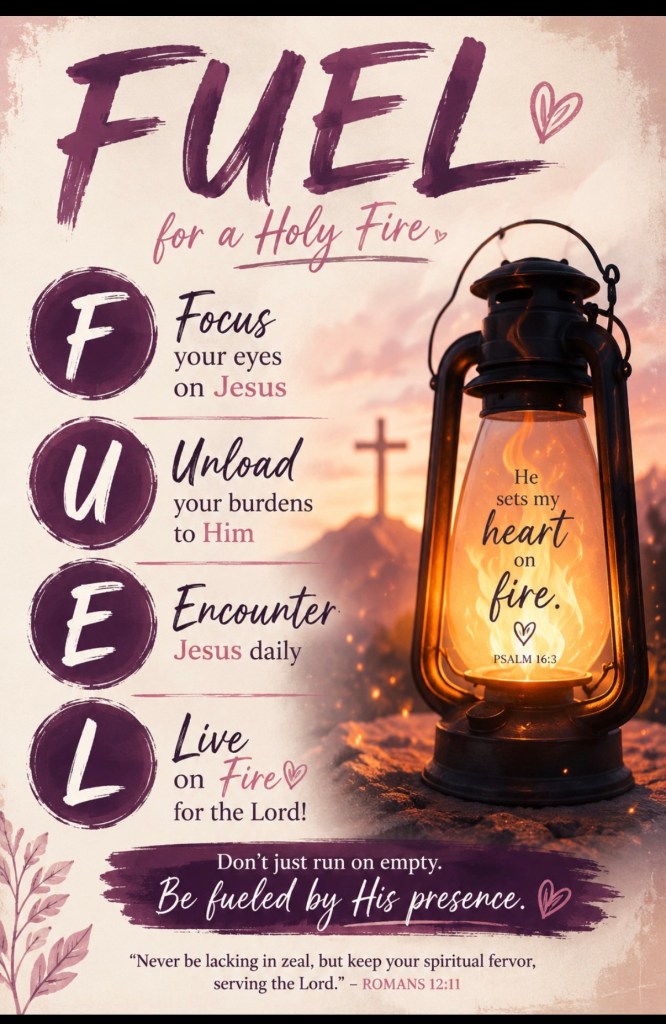
FUEL: Four Habits That Feed a Holy Fire
“Never be lacking in zeal, but keep your spiritual fervor, serving the Lord.” — Romans 12:11
A fire never stays alive because it burned brightly yesterday.
You can build the perfect campfire. Stack the wood just right. Watch the flames leap into the night sky. But if you never return to it, if you never add another log, eventually all that’s left is ash. The glow fades. The heat disappears. What was once alive becomes cold.
Faith works much the same way.
Many of us remember seasons when our hearts burned for Jesus. We couldn’t wait to open our Bible. Prayer wasn’t a duty—it was a conversation. Worship wasn’t something we attended; it was the atmosphere we lived in.
Then life happened.
Responsibilities piled up. Disappointments settled in. Grief visited. Suffering lingered. The ordinary rhythms of life slowly crowded out the extraordinary presence of God. We didn’t reject Jesus. We just stopped feeding the fire.
The good news is that God doesn’t abandon smoldering believers.
Isaiah prophesied of the coming Messiah:
“A bruised reed He will not break, and a smoldering wick He will not snuff out.” (Isaiah 42:3)
Jesus doesn’t despise weak flames.
He breathes life into them.
Romans 12:11 gives us one of the clearest pictures of what a healthy spiritual life looks like:
“Never be lacking in zeal, but keep your spiritual fervor, serving the Lord.”
The Greek word translated “fervor” is ζέω (zeō), meaning to boil, to bubble over, to burn with heat. It’s the picture of water placed over a fire until it can’t help but boil. Paul isn’t telling believers to manufacture emotion. He’s calling us to stay close enough to God that the Holy Spirit keeps our hearts spiritually boiling rather than spiritually cooling.
So how do we keep adding wood to the fire?
One simple word helps me remember:
FUEL.
F — Focus Your Eyes on Jesus
Everything begins with where we look.
The writer of Hebrews tells us:
“Let us run with endurance the race set before us, fixing our eyes on Jesus, the pioneer and perfecter of our faith.” (Hebrews 12:1–2)
The phrase “fixing our eyes” comes from the Greek word ἀφοράω (aphoraō), which means to look away from everything else in order to look intently at one thing.
Notice what that means.
Before we look to Jesus, we must look away from something else.
Away from fear.
Away from comparison.
Away from our failures.
Away from our own strength.
The Christian life isn’t sustained by glancing at Christ between distractions. It’s sustained by continually re-centering our gaze upon Him.
Peter demonstrates this perfectly.
As long as his eyes remained on Jesus, he walked on water. The waves didn’t suddenly become smaller. The storm didn’t disappear. What changed was Peter’s focus.
The moment his attention shifted to the wind, he began to sink (Matthew 14:28–31).
Isn’t that often our story?
We spend hours staring at problems and only minutes staring at Christ.
No wonder our anxiety grows larger while our faith grows smaller.
The psalmist understood this long before Peter ever stepped onto the Sea of Galilee.
Psalm 121 begins:
“I lift up my eyes to the hills—where does my help come from? My help comes from the Lord…”
The Hebrew word for lift carries the idea of intentionally raising one’s gaze. Hope begins when our eyes leave the circumstances beneath us and rise toward the God above us.
Whatever has your attention eventually has your affection.
And whatever has your affection will shape your life.
Fuel Check
Where have your eyes been lately?
On headlines?
On your diagnosis?
On your finances?
Or on Christ?
U — Unload Your Burdens to Him
One of the greatest reasons our spiritual fire burns low is because we’re carrying things God never asked us to carry.
Jesus extends one of the most beautiful invitations in all of Scripture:
“Come to Me, all who labor and are heavy laden, and I will give you rest.” (Matthew 11:28)
The phrase “heavy laden” describes someone bent beneath an impossible load.
Some of us know that posture well.
We’re carrying guilt from years ago.
Fear about tomorrow.
Shame over yesterday.
Pressure to hold everyone together.
Trying to control outcomes only God can control.
Peter writes:
“Cast all your anxiety on Him because He cares for you.” (1 Peter 5:7)
The Greek word ἐπιρίπτω (epirriptō) means to throw upon, to place completely on someone else.
Not hand Him part.
Throw Him all.
David paints the same picture in Psalm 55:22:
“Cast your burden on the LORD, and He will sustain you.”
The Hebrew word for cast is שָׁלַךְ (shalakh)—to hurl or throw down.
God never asked you to carefully manage your burdens.
He asked you to surrender them.
Prayer isn’t merely talking to God.
It’s unloading onto God.
Every burden surrendered becomes more room for peace.
Every anxiety released becomes more room for worship.
E — Encounter Jesus Daily
Healthy relationships aren’t built on occasional visits.
They’re built through daily presence.
Jesus never called people to occasionally admire Him.
He called them to abide.
“Abide in Me, and I in you.” (John 15:4)
The Greek word μένω (menō) means to remain, dwell, continue, stay at home.
It’s not a weekend retreat.
It’s a permanent address.
Israel learned this lesson every morning in the wilderness.
God supplied manna one day at a time.
Yesterday’s bread spoiled.
Yesterday’s provision wasn’t enough for today’s journey.
The same is true spiritually.
Yesterday’s sermon can’t replace today’s surrender.
Yesterday’s worship can’t replace today’s communion.
Jeremiah wrote:
“Your words were found, and I ate them…” (Jeremiah 15:16)
Notice the imagery.
God’s Word isn’t simply studied.
It’s consumed.
Encountering Jesus daily means opening Scripture not simply looking for information but expecting transformation.
It means praying before checking notifications.
It means creating space where the noise of the world becomes quiet enough for the whisper of God to be heard.
Elijah didn’t encounter God in the earthquake.
Not the wind.
Not the fire.
But in the gentle whisper (1 Kings 19:11–13).
Sometimes the greatest obstacle to hearing God isn’t His silence.
It’s our constant noise.
L — Live on Fire for the Lord
Eventually what happens privately begins showing publicly.
The purpose of the fire isn’t merely to warm us.
It’s to shine through us.
Jesus declared:
“You are the light of the world…” (Matthew 5:14)
The fire of God has always been missional.
From the burning bush…
To the pillar of fire…
To the tongues of fire at Pentecost…
God’s fire has always revealed His presence and empowered His people.
Acts 2 tells us that when the Holy Spirit came, tongues as of fire rested upon each believer.
Fire in Scripture often symbolizes God’s holy presence, His refining work, and His empowering Spirit.
When God fills a life, people notice.
Not because we become louder.
But because we become more like Jesus.
We forgive when revenge feels easier.
We love when hatred feels justified.
We serve when comfort feels appealing.
We remain faithful when quitting seems reasonable.
That’s holy fire.
Romans 12:11 calls believers to continual spiritual fervor because the world desperately needs people who are more than religious.
It needs people who have been with Jesus.
Keep Feeding the Flame
The enemy would love for you to believe your best days with God are behind you.
That the fire you once knew is gone forever.
But Scripture tells a different story.
Paul told Timothy:
“Fan into flame the gift of God…” (2 Timothy 1:6)
The Greek expression literally pictures stirring glowing embers until fresh flames rise again.
Sometimes revival doesn’t begin with a stadium.
Sometimes it begins with one believer opening their Bible before sunrise.
One surrendered prayer.
One act of repentance.
One whispered, “Jesus, I need You.”
One log placed back on the fire.
You don’t have to create the flame.
Only God can do that.
But you can keep bringing Him the fuel.
Focus your eyes on Jesus.
Unload every burden into His hands.
Encounter Him every single day.
Live on fire for His glory.
The world has enough smoke.
It needs believers who are burning.
So today, don’t settle for surviving your faith.
Don’t settle for yesterday’s embers.
Step closer to the One who is Himself called “a consuming fire” (Hebrews 12:29).
And as you draw near to Him, you’ll discover something beautiful:
The closer you get to the Fire…
the more you begin to burn—not with anger or pride, but with love, holiness, courage, compassion, and joy.
That’s the kind of fire the Holy Spirit loves to kindle.
That’s the kind of life that changes the world.
Fuel Check
Before you close this page, pause and ask yourself four simple questions:
- F: Where have my eyes drifted from Jesus?
- U: What burden do I need to surrender today?
- E: How will I intentionally encounter Jesus tomorrow morning?
- L: Does my life reflect the warmth and light of Christ to those around me?
May your answer not simply be words.
May it become the way you live.
“Never be lacking in zeal, but keep your spiritual fervor, serving the Lord.” — Romans 12:11


Leave a Reply