Most of us have more access to Scripture than any generation before us. We have three dusty Bibles on a shelf, ten translations on our phones, and a beautiful leather Bible we carry to church like an accessory. Some of us were even taught not to write in it, as though God’s Word were a museum piece to be preserved instead of living bread to be eaten.
But if the pages stay clean while our hearts stay dusty, what good is all that access?
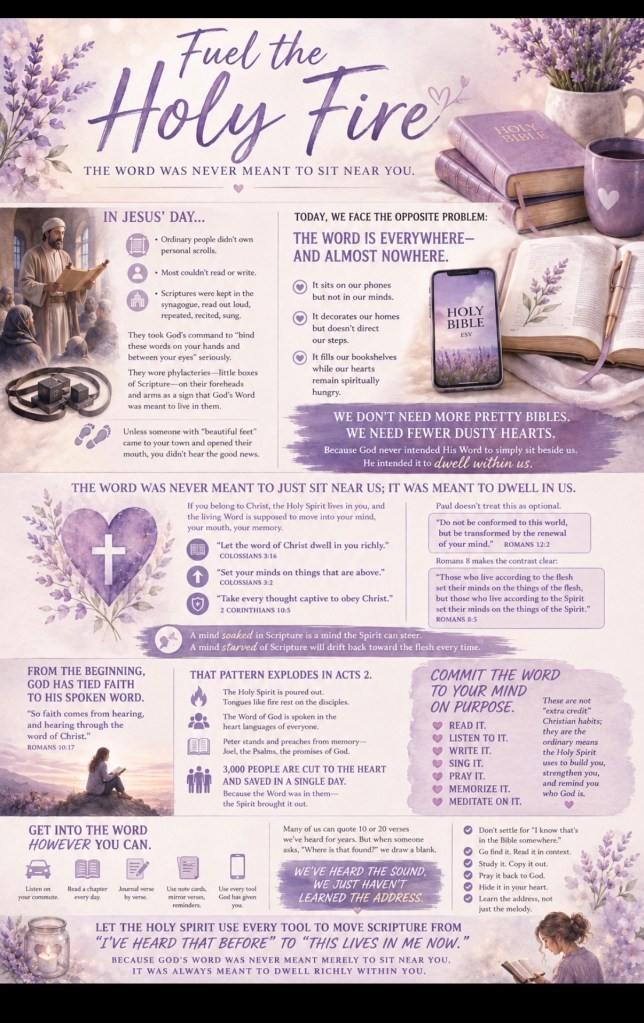
In Jesus’ day, ordinary people didn’t carry personal copies of the Scriptures. Scrolls were expensive, literacy was limited, and the sacred writings were kept in the synagogue. People gathered to hear them read aloud, repeated, recited, discussed, and sung. Faith was cultivated through hearing God’s Word over and over until it became part of who they were.
The Jewish people even took God’s command in Deuteronomy 6 seriously enough to literally bind His words to themselves. They wore phylacteries—small leather boxes containing portions of Scripture—strapped to their foreheads and wrapped around their arms as a visible reminder that God’s Word was to shape their thoughts and their actions. The physical symbol pointed to a spiritual reality: His Word was meant to live in them.
And unless someone with “beautiful feet” came proclaiming the good news (Romans 10:15), many people would never hear it.
Today we face the opposite problem.
The Word is everywhere—and almost nowhere at the same time.
It sits on our phones but not in our minds.
It decorates our homes but doesn’t direct our steps.
It fills our bookshelves while our hearts remain spiritually hungry.
We don’t need more pretty Bibles.
We need fewer dusty hearts.
Because God never intended His Word to simply sit beside us. He intended it to dwell within us.
If you belong to Christ, the Holy Spirit lives in you. And the Spirit delights in filling your mind with the Word He inspired. Scripture was never meant to remain ink on a page; it was meant to become the language of your heart, the meditation of your mind, and the confession of your mouth.
Paul repeatedly calls believers to this reality.
“Let the word of Christ dwell in you richly” (Colossians 3:16).
“Set your minds on things that are above” (Colossians 3:2).
“Take every thought captive to obey Christ” (2 Corinthians 10:5).
That isn’t simply an invitation to think more positively. It’s a call to fill your inner life so completely with Scripture that when lies pull into the parking lot of your mind, they immediately have to answer to what God has already said.
Paul doesn’t treat this as optional. In Romans 12:2 he writes,
“Do not be conformed to this world, but be transformed by the renewal of your mind.”
That renewal doesn’t drift in through good intentions. The Holy Spirit renews our minds through the Word we actually receive.
Romans 8 makes the contrast even sharper:
“Those who live according to the flesh set their minds on the things of the flesh, but those who live according to the Spirit set their minds on the things of the Spirit.”
The Greek word Paul uses, phronousin, speaks of one’s mindset, affections, and habitual way of thinking. A mind saturated with Scripture becomes a mind the Spirit can continually direct. A mind starved of Scripture will naturally drift back toward the desires of the flesh.
From the very beginning, God has connected faith with His spoken Word.
“So faith comes from hearing, and hearing through the word of Christ” (Romans 10:17).
That pattern bursts into flame in Acts 2.
The Holy Spirit is poured out. Tongues like fire rest upon the disciples. Suddenly the mighty works of God are proclaimed in the heart languages of the people gathered in Jerusalem.
Then Peter stands and preaches.
Notice what pours out of him.
Joel.
The Psalms.
The promises of God.
He isn’t reading from a scroll. The Scriptures have already been written on his heart. When the Spirit lights the fire, the Word comes pouring out.
Three thousand people are cut to the heart and saved in a single day—not because everyone suddenly received a personal Bible, but because the disciples had hidden God’s Word within themselves and the Holy Spirit empowered its proclamation.
The same Spirit still works that way today.
So commit the Word to your mind on purpose.
Read it.
Listen to it.
Write it.
Sing it.
Pray it.
Memorize it.
Meditate on it until it becomes part of how you think.
These aren’t “extra-credit” Christian disciplines. They are the ordinary means the Holy Spirit uses to strengthen believers, renew minds, expose lies, comfort suffering hearts, and remind us who God is when our emotions and circumstances are shouting something entirely different.
You cannot consistently live a Spirit-filled life with a Scripture-starved mind.
Get into the Word however you can.
Maybe it’s listening to Scripture on your commute.
Maybe it’s reading one chapter every morning.
Maybe it’s journaling verse by verse with a pen and highlighter.
Maybe it’s writing verses on note cards or putting them on your bathroom mirror.
Use every tool available.
Many of us can quote ten or twenty verses we’ve heard for years. But when someone asks, “Where is that found?” we draw a blank.
We’ve heard the sound.
We just haven’t learned the address.
Don’t settle for saying, “I know that’s in the Bible somewhere.”
Go find it.
Read the verses before it and after it.
Study the context.
Copy it into a journal.
Pray it back to God.
Hide it in your heart.
Let HIS Word speak to you daily.
Learn the address, not just the melody.
Let the Holy Spirit use every available tool—apps, audio Bibles, journals, note cards, conversation, and repetition—to move Scripture from “I’ve heard that before” to “This lives in me now.”
Because God’s Word was never meant merely to sit near you.
It was always meant to dwell richly within you. Love your sister in Christ Sunnye ☀️


Leave a comment