
Many of you know this feeling.
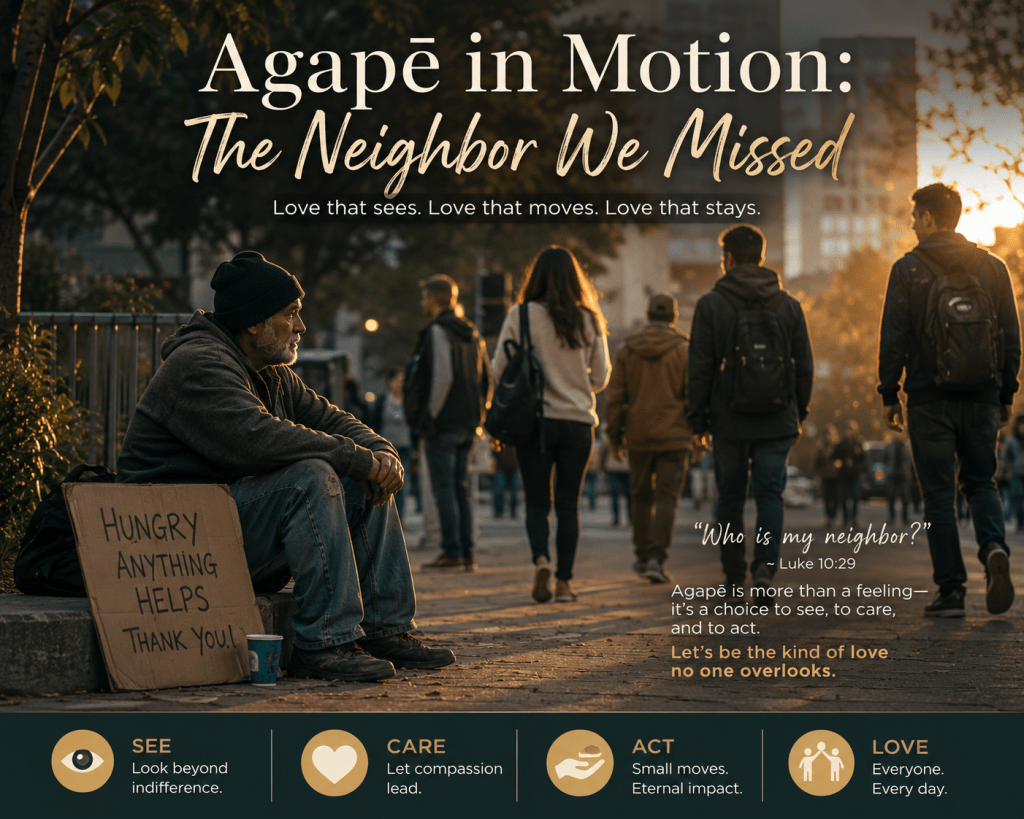
You’re driving, running late, your mind already on the next thing, and you see them standing on the corner. A cardboard sign. A weathered face. Someone’s son or daughter asking for help.
Or maybe you’re walking into a store and there’s a person sitting outside with everything they own packed into a couple of bags.
If you’re anything like me, your heart stirs for a moment… and then your mind starts making excuses.
“They’re just lazy.”
“They got themselves into this.”
“If I give them money, they’ll just buy drugs or alcohol.”
“It’s like that scene in Liar Liar when Jim Carrey finally blurts out to the beggar, ‘I’m not giving you money because I believe you’ll just buy booze with it.’ He simply says out loud what many of us quietly think.
We convince ourselves that our indifference is wisdom. We call it being responsible or being a good steward.
But it doesn’t stop at red lights.
I see it all over social media:
“We don’t need shelters here.”
“If they’re homeless, they should go somewhere else.”
“We don’t want that population in our community.”
As if moving broken people away somehow moves sin away.
The truth is that many of the people sleeping under bridges or walking our streets aren’t outsiders. They grew up here. They went to our schools. They played on our ball fields. They sat in our churches.
They’re our neighbors.
And yet we label them so we can keep our conscience clean.
“They’re addicts.”
“They’ll just waste it.”
We act as though addiction, mental illness, or trauma somehow strips away a person’s worth.
But Jesus never said,
“I was hungry, and you fed Me—as long as I’d passed a drug test.”
He simply said:
“I was hungry… I was thirsty… I was a stranger… I was naked… I was sick… I was in prison.”
No conditions. No qualifiers.
I used to think driving past was neutral.
“I didn’t hurt them. I just didn’t help.”
But then I read Matthew 25
Jesus says there will come a day when people stand before Him, and He says,
“I was hungry and you gave Me no food. I was thirsty and you gave Me no drink. I was a stranger and you did not welcome Me.”
And they’ll ask,
“Lord, when did we see You?”
And He answers,
“As you did not do it to one of the least of these, you did not do it to Me.”
That verse has haunted me.
Because it means Jesus ties Himself to the very people I’m tempted not to see.
Not long ago, God stopped letting this stay theoretical.
Every morning on my way to work, I’d see the same woman walking along the road with a bag over her shoulder. Sometimes I’d hand her a blessing bag through my window and keep driving. I’d feel that little tug in my spirit, then drown it out with excuses.
“I don’t have time.”
“Somebody else will help.”
“I don’t even know what to say.”
One morning, I couldn’t shake it.
It felt like the Holy Spirit was sitting in the passenger seat saying,
“You’re not driving past her again.”
So I pulled over.
I got out of my car and walked up the hill toward her.
I asked her name.
She said, “Zoe.”
Not “the homeless woman.”
She has a name, Zoe.
She told me she’d been raised by her grandparents, struggled with mental illness, lost the person she was living with, and was eventually evicted. Now she keeps her belongings in a storage unit and survives however she can.
I don’t know every detail of her story.
But I saw trauma.
I saw loss.
I saw someone without a safety net or support system.
Then I really looked at her.
Her eyes were the exact same color as my oldest daughter’s.
In that moment, it hit me:
She could have been my daughter.
She is somebody’s daughter.
She bears the image of God just as much as I do.
Zoe told me she believed in God but had never really read the Scriptures for herself.
So I gave her a Bible I had with me. I had marked passages about God’s love, provision, strength, forgiveness, and hope. I tucked some cash inside.
When I handed it to her, she looked at me and asked,
“Are you sure you want to give this to me?”
I told her,
“Yes. These verses all point back to Jesus. He knows your story, and He hasn’t forgotten you.”
We talked about local resources and places she might find help.
Before I left, I asked if there was anything else she needed.
She looked at me and quietly said,
“Could you just hug me?”
So I did.
And she hugged me back like she meant it.
That hug didn’t solve everything.
It didn’t erase her pain or instantly give her a home.
But it reminded me what love actually looks like.
Jesus didn’t just tell us to love our neighbors. He showed us.
He touched lepers.
He stopped for beggars.
He washed dirty feet.
The Greek word for that kind of love is agapē—a sacrificial, self-giving love that moves toward people instead of away from them.
The same love that carried Christ to the cross.
In Luke 10, when Jesus tells the story of the Good Samaritan, the religious people cross to the other side of the road.
The Samaritan stops.
He sees.
He comes near.
He bandages wounds.
He gives his time, his money, and his comfort.
Then Jesus says,
“Go and do likewise.”
Neighbor isn’t just the person who lives next door.
Neighbor is whoever God places in front of you.
The man with the cardboard sign.
The woman walking the roadside.
The addict.
The broken.
The forgotten.
The question isn’t whether they’re our neighbor.
Jesus already answered that.
The real question is whether we’ll cross to the other side to protect our comfort—or whether we’ll come near and show mercy.
Because somewhere in all of this, I think Jesus is still whispering:
“Whatever you did for one of the least of these brothers and sisters of Mine, you did for Me.”
“So when that moment comes—the stoplight, the parking lot, the person on the corner—we’re not just deciding what to do with them. Are we practicing Agapē in Motion? ☀️ Sunnye
 Holy Moments in a Worn‑Out Life: Time Well Spent Turning Back to the Word
Leave a comment